Shopify Store Audit Service: How to Choose in 2026

A Shopify store audit service reviews your product listings and store setup, then tells you what is broken. The best ones also fix it. For a small store, that last part matters most: a report you never have time to act on fixes nothing. Below, we compare the real options by price, turnaround and who does the work, so you can pick the one that fits your store.
TL;DR
- A store audit is a structured review of your listings and setup. Some services only hand you a report. Others fix what they find.
- Prices in this field run from about $35 on freelance marketplaces to $1,500 to $3,000 or more at CRO agencies (agencies that specialize in turning more visitors into buyers).
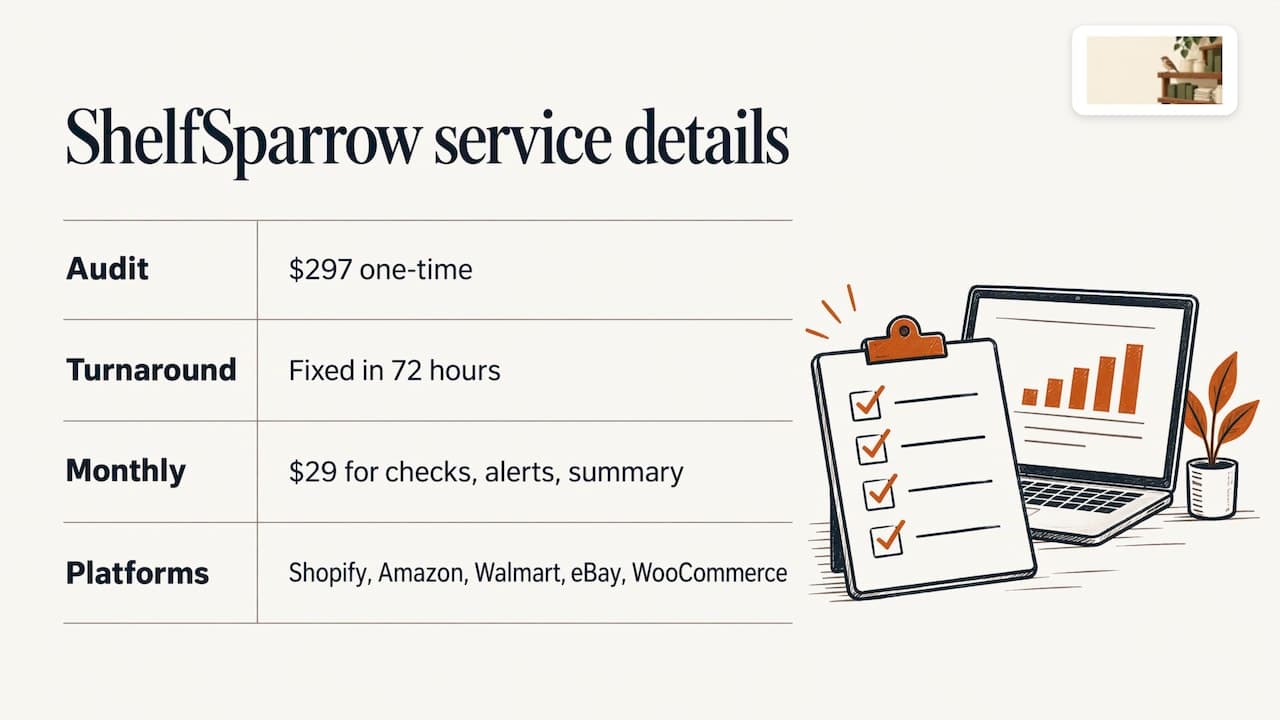
- ShelfSparrow is a done-for-you service, not software: a $297 one-time listing audit with fixes in 72 hours, then $29 a month for ongoing checks, stock alerts and daily summaries.
- Audit apps scan and flag. Services add a human who sets priorities. The strongest setup is both: constant watching plus someone who fixes.
- Audit your listings at least when you launch, when you add a batch of products, and then keep a light monitor running between audits.
Table of Contents
- What a Shopify store audit actually covers
- Audit service or audit app: what is the difference?
- The options compared
- Which one fits your store
- What to expect from an audit
- How often to audit your listings
- Our perspective
- Start with the audit
- FAQ
- Sources
What a Shopify store audit actually covers
An audit is a review of your store against a checklist, with the problems ranked so you know what to do first. Scope varies a lot by provider. Some audits look at the whole store: speed, apps, technical SEO (the settings that help search engines read your pages), checkout and tracking. Others focus on the product listings only.
A listing audit looks at the things your customers see on each product page. Shopify’s own product details page documentation lists the fields that make up a listing: title, description, media, category, pricing, inventory, variants and the search engine listing. Those fields are where most everyday leaks happen.
Here is what a good listing audit checks, in plain words:
- Titles. Is the product name clear, consistent and written the way shoppers search?
- Descriptions. Are they unique, readable and free of typos? If you resell, copying the manufacturer’s text means search engines see the same words on many sites.
- Images. Do they load? A broken image is a blank box where a product photo should be.
- Search engine listing. This is the page title and short summary that can show up in Google. If it is empty or duplicated, shoppers get less reason to click.
- Stock and variants. Are sizes, colors and quantities accurate, and are items running low?
- Pricing and category. Do prices match across variants, and is each product filed in the right category?
That list is small on purpose. Most small stores do not need a 200-point review. They need the leaks found and closed.
Audit service or audit app: what is the difference?
This is the question behind “Shopify audit service vs app,” and the answer is about who does the work.
An audit app is software you install. It scans your pages, spots patterns and re-checks on a schedule. According to one comparison of SEO audit services and automated Shopify audits, apps scan many URLs cheaply and watch for problems coming back, but the fixing is usually separate and the instructions can be generic. A professional audit service adds a person who interprets the findings, finds the root cause and ranks what matters. Fixes may be included or quoted as a second phase.
So the practical difference is this:
| Audit app | Report-only service | Done-for-you service | |
|---|---|---|---|
| Who finds issues | Software | A person plus tools | A person plus tools |
| Who fixes them | You | You, or a quote for extra work | The provider |
| Ongoing watching | Yes, usually | Rarely | Depends on the provider |
| Your time needed | Learning a dashboard, then doing the fixes | Reading the report, then doing the fixes | Little |
If you enjoy tinkering and have the hours, an app is a fair fit. If you run a small store and your week is already full, a report or a dashboard can become one more list that sits unread. That is the gap a done-for-you service closes.
The options compared
Here is the field as small-store owners meet it, with the prices and terms as we know them. Providers change their pricing, so check each official page before you buy.
| Option | Type | One-time audit | Turnaround | Fixes included? | Ongoing watch |
|---|---|---|---|---|---|
| ShelfSparrow | Done-for-you service | $297 | 72 hours | Yes: titles, SEO, typos, broken images | $29/month |
| Lydia | AI store management | $497 | Report in 48 hours | Report-led | $1,997/month |
| Speechify Boost | Audit with drafted fixes | Not listed here | Not listed here | Drafted for your approval | Weekly digest |
| OptraSeven | Shopify CRO agency | $149 founding offer, $297 regular | Not listed here | Deep audit | None at $29/month level |
| Focused Developer | Shopify audit | €150 | 5 business days | Report | None listed |
| Upwork and Fiverr freelancers | Marketplace | $35 to $1,299 | Varies by seller | Mostly report-only | Mostly none |
| CRO agencies | Agency | $1,500 to $3,000 or more | Varies | Tactical audit | Separate retainer |
Let’s walk through each.
ShelfSparrow
We are a done-for-you store auditing service, not software. Our audit is $297 one-time and covers titles, SEO, typos and broken images, fixed in 72 hours. You get a plain-English, prioritized report too, so you can see what changed and what is left.
After the audit, $29 a month buys listing checks, stock alerts and a daily summary. We also audit any online store or marketplace, including Amazon, Walmart, eBay and WooCommerce, so you are not limited to one platform. We built this for small online sellers who want leaks fixed, not another dashboard to learn.
Lydia
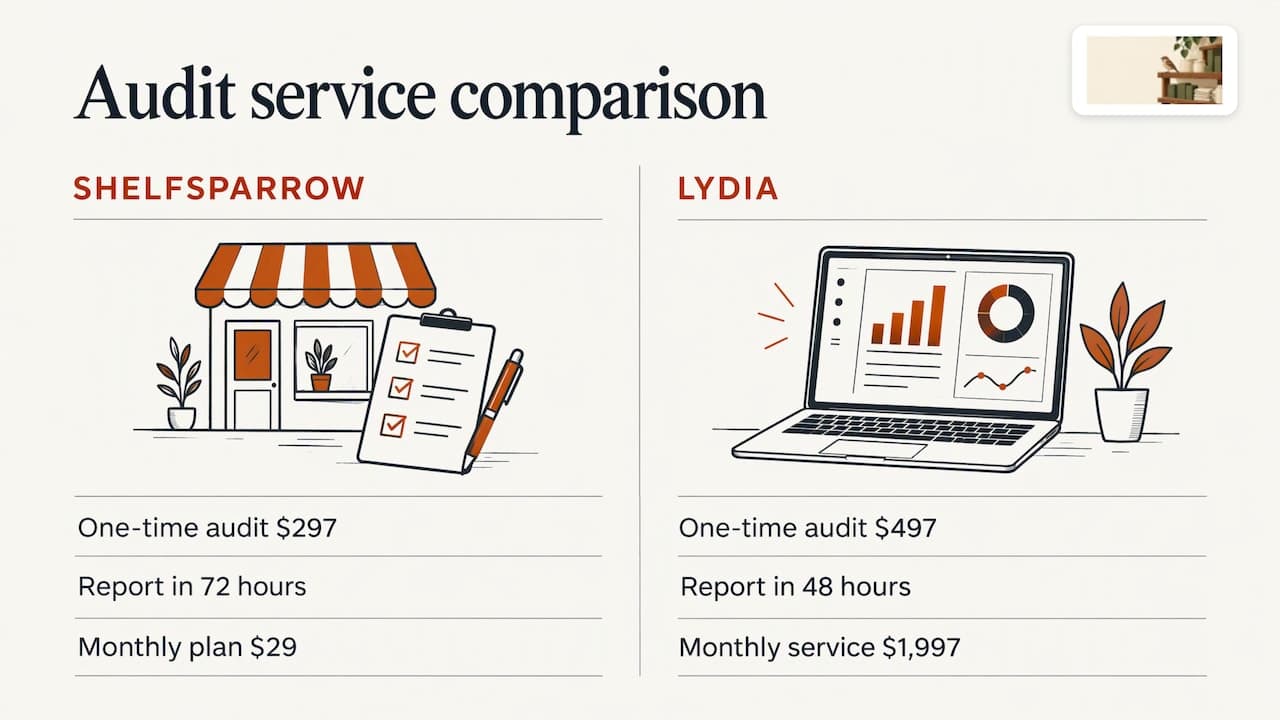
Lydia is the closest branded rival: AI store management for Shopify and Etsy, with audits across 9 categories. It charges $497 for a one-time audit with the report in 48 hours, then $1,997 a month for ongoing service. Our $297 audit and $29 monthly plan undercut Lydia at both ends. For a store doing modest monthly sales, that monthly gap is the deciding number.
Speechify Boost
Speechify Boost audits your products and drafts the fixes (titles, copy, photos and meta text, which is the short search summary) for you to approve, plus a weekly digest. The approval step means every change waits on you. ShelfSparrow fixes issues on the spot, so a typo or a broken image is gone without sitting in your inbox.
OptraSeven
OptraSeven is a Shopify CRO agency. Its deep audit has been listed at $149 as a founding offer against a $297 regular price. It targets brands doing $200k to $5M a year, and it has no $29-a-month watchdog offering. If you are a smaller seller who wants steady upkeep rather than a one-off strategy review, that is a different lane.
Focused Developer
Focused Developer offers a €150 Shopify audit with the report in 5 business days. It offers money back if fewer than 5 fixes are found. That is a clear, small-shop-friendly deal. The difference is the format: you receive a report and do the work yourself, while our audit includes the fixes within 72 hours.
Freelancers on Upwork and Fiverr
Audit freelancers on Upwork and Fiverr run from $35 to $1,299. Most deliver a report only, with no monthly watch afterward. Quality depends on the individual, so you will spend time reading profiles and comparing scopes.
CRO agencies
Real CRO agencies charge $1,500 to $3,000 or more for a tactical audit. That buys deep analysis for larger brands with the budget and team to act on it.
Prediko, Sellbrite and StoreClaw
You will also see Prediko, Sellbrite and StoreClaw in this search. These are software tools, so you install them, learn them and run them yourself. They suit teams that want a dashboard. If you would rather not add one, a done-for-you service is the simpler path.
Which one fits your store
Pick by the problem you actually have.
- You suspect your listings are sloppy and you have no time. Choose a service that fixes, not one that reports. Our $297 audit is built for this.
- You want a strategy review for a larger brand. An agency or a CRO-focused audit fits better, and the budget should match.
- You like doing the work yourself. A report-only audit from a freelancer or a small shop can be enough. Be honest about whether you will get to the list.
- Stock surprises keep hurting you. Look for stock alerts and a daily summary, not just a one-time check.
- You sell on more than one channel. Confirm the provider covers your marketplaces. We cover Amazon, Walmart, eBay and WooCommerce, along with Shopify and Etsy.
What to expect from an audit
Whatever you buy, ask these questions before paying:
- What is reviewed? Listings only, or the whole store?
- Who makes the changes? You, or the provider?
- How fast? Hours, days or weeks.
- What do you get in writing? A prioritized list is more useful than a long dump of findings.
- What happens next? Is there any ongoing watching, or does it end at the report?
A good deliverable is short. It names the problem, shows where it is, says whether it was fixed and ranks what is left by how much it affects sales.
How often to audit your listings
There is no official schedule. A sensible rhythm for a small store looks like this:
- At launch, before you spend on ads or promotion.
- After a big catalog change, such as a new collection, a supplier switch or a bulk import.
- Once or twice a year for a deeper review.
- Continuously for the small stuff: a typo, a broken image, a product about to sell out. These happen between audits, which is why a light monitor earns its place.
The point of watching between audits is that small errors pile up quietly. A product photo breaks when a file is moved. A variant runs out and nobody notices for a week.
Our perspective
We started from one observation: most store problems are not hard. They are small, routine and easy to miss. A typo in a title. A photo that stopped loading. A bestseller down to its last few units.
Owners do not ignore these on purpose. They are busy running the business. So a dashboard full of warnings often becomes one more thing to feel behind on.
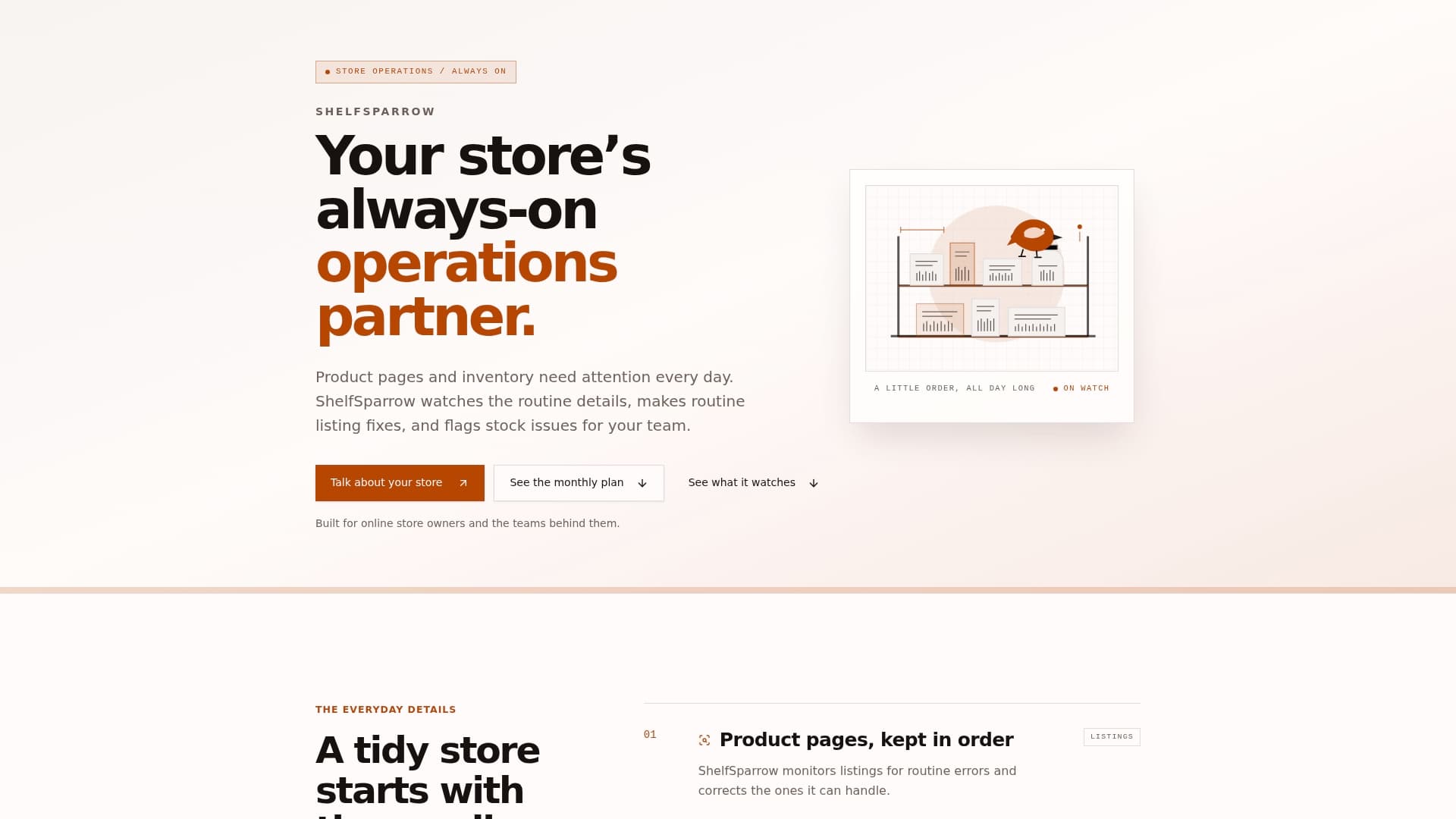
That is why we run ShelfSparrow as a done-for-you service. We keep a steady eye on your listings and inventory, fix routine errors when we find them and flag low stock before it costs you a sale. You get a short daily summary instead of a wall of alerts.
The $297 audit clears the backlog in 72 hours. The $29 monthly plan keeps it clear. A little order, all day long.
Francis
Start with the audit
If your listings have not had a careful look in a while, begin there. Our store audit is $297 one-time: titles, SEO, typos and broken images fixed in 72 hours, with a plain-English report that ranks what is left. Afterward, the plan at $29 a month adds listing checks, stock alerts and daily summaries. You can see everything on the ShelfSparrow home page.
If you sell on Etsy too, our Etsy listing SEO checklist walks through ten fixes that help buyers find your products.
FAQ
How much does a Shopify store audit cost?
It ranges widely. Freelancers on Upwork and Fiverr run $35 to $1,299, and CRO agencies charge $1,500 to $3,000 or more. ShelfSparrow’s audit is $297 one-time, with fixes included.
Is a store audit worth it for a small shop?
It is worth it when the audit leads to fixes. Small errors in titles, images and stock can cost sales without anyone noticing. A service that corrects them for you turns the findings into results instead of a to-do list.
What is the difference between a listing audit and a full store audit?
A listing audit checks the product pages: titles, descriptions, images, search text, variants and stock. A full store audit also reviews speed, apps, tracking and checkout. Small stores often get the most from the listing audit first.
Do I need an app if I have a service?
Not necessarily. An app gives you a dashboard to read and act on. With ShelfSparrow, we do the watching and fixing, and you get a daily summary, so there is nothing new to learn.