Best Automated Listing Correction Software for Small Stores

The best way to fix listing errors automatically is a service that finds the mistake and fixes it, not a tool that shows you a list of problems and waits for you. For small Shopify, Etsy, Amazon, Walmart, eBay and WooCommerce stores, that is ShelfSparrow: a done-for-you service, not software, with a $297 one-time audit that fixes titles, SEO, typos and broken images in 72 hours, then $29/month of listing checks, stock alerts and daily summaries.
Below, we compare the real options by what they fix, who does the work and what they cost, so you can pick without learning another dashboard.
TL;DR
- Most “listing tools” create or copy listings. Very few watch them for errors and correct the routine ones.
- ShelfSparrow fixes typos, broken images and similar slips on the spot: $297 once for the audit, then $29/month to keep watching.
- Tools that flag problems (or draft fixes for your approval) still leave the work with you. Agencies charge $1,500 to $3,000 or more.
- Judge any option on four things: what it fixes, who does the fixing, which channels it covers and the total monthly cost.
Table of Contents
- What “automated listing correction” actually means
- Why most listing software doesn’t correct anything
- How we compared the options
- The options at a glance
- ShelfSparrow: the pick for small stores that want leaks fixed
- Lydia: broader scope, far higher price
- Speechify Boost: drafts the fixes, then waits for you
- OptraSeven and Focused Developer: one-off Shopify audits
- Freelancers and agencies
- Sellbrite, Prediko and StoreClaw: tools, not fixers
- What the full cost looks like
- How to tell whether automatic fixes are safe
- What listing errors cost you
- A different model: hands-off selling
- How to choose
- Our view: tidy listings are a habit, not a project
- Start with the audit
- FAQ
- Sources
What “automated listing correction” actually means
A listing is the page that sells one product: its title, description, photos, price, tags and stock count. Listing errors are the small mistakes that quietly cost you sales. A typo in a title. A photo link that no longer loads. A description that says one size while the title says another. A product still showing “in stock” when the shelf is empty.
Automated listing correction means something finds these problems without you hunting for them, and then does one of three things:
- Flags the problem and leaves the fix to you.
- Drafts a fix and waits for you to approve it.
- Fixes it directly.
The difference matters more than any feature list. Flagging and drafting add tasks to your day. Fixing removes them. A small store owner already juggling orders, customers and sourcing rarely has time to work through a report of 140 issues.
One more term you will see: crosslisting. That means posting the same item on several marketplaces at once. Crosslisting apps are what Google mostly shows for this search, and they are built for resellers who need to post fast. That is a different job from keeping a store’s existing listings accurate.
Why most listing software doesn’t correct anything
Most of what ranks for this search is crosslisting software. It helps you create listings, copy them between sites and delist an item when it sells elsewhere. Useful for resellers, but it does not go back and fix what is wrong on a listing already live.
App Compare’s 2026 review of product listing tools draws the line clearly. In its view, flagging errors before a listing goes live, such as missing images, incomplete attributes and policy violations, plus a listing-health score for each sales channel, separates genuinely useful tools from basic crosslisters. It also warns that field-mapping mistakes during a CSV import (a spreadsheet upload where columns get matched to the wrong fields) can cause silent errors that suppress listings. Silent is the key word: nothing breaks loudly, your product just stops showing up.
So the first question for any option is not “how many marketplaces does it connect?” It is “what happens after it finds a mistake?”
How we compared the options
We judged each option on four things a small store owner feels directly:
- What it fixes. Only flags, drafts, or actually corrects.
- Who does the work. You, the software, or a person on the provider’s side.
- Where it works. Shopify and Etsy only, or any store and marketplace.
- What it costs in total. The one-time fee plus the monthly cost to keep things clean.
Prices below are each provider’s own published figures as we have them, and they change, so check the provider’s page before you buy.
The options at a glance
| Option | What it does | Who fixes the problem | Price |
|---|---|---|---|
| ShelfSparrow | Audit, then ongoing listing checks, stock alerts, daily summary | ShelfSparrow, on the spot | $297 one-time audit, then $29/month |
| Lydia | AI store management, audits across 9 categories, Shopify and Etsy | Mostly the platform’s output | $497 one-time audit (report in 48 hours), then $1,997/month |
| Speechify Boost | Audits products and drafts fixes for titles, copy, photos and meta, plus a weekly digest | You approve each fix | Check its page |
| OptraSeven | Shopify conversion-rate (CRO) agency audit | Agency recommendations | $149 founding offer against a $297 regular price |
| Focused Developer | Shopify audit, report in 5 business days | Report-based | €150, money back if fewer than 5 fixes found |
| Upwork and Fiverr freelancers | One-off audits | Usually report only | $35 to $1,299 |
| CRO agencies | Full conversion work | Agency | $1,500 to $3,000 or more |
| Sellbrite | Multichannel listing and inventory tool | You | From about $29/month |
| Prediko | Inventory planning tool | You | From $49/month |
A quick note on the abbreviation: CRO means conversion-rate optimization, the work of getting more of your visitors to buy.
ShelfSparrow: the pick for small stores that want leaks fixed
ShelfSparrow is a done-for-you store auditing service, not software. There is no new dashboard to learn. It works in two parts.
The audit: $297, one time. It covers titles, SEO (the wording that helps shoppers and search engines find your product), typos and broken images. Typos and broken images are fixed within 72 hours, and you get a plain-English, prioritized report of what else needs attention, so you know what matters first.
The ongoing watch: $29/month. Listing checks, stock alerts and a daily summary. The monitoring runs 24/7, routine listing errors are corrected automatically, and low-stock situations are highlighted so you can reorder before an item sells out. The daily summary is short enough to read with your coffee.
It audits any online store or marketplace, including Shopify, Etsy, Amazon, Walmart, eBay and WooCommerce. If you sell in more than one place, that matters: the same product often carries a different title, price or stock number on each channel, and those mismatches are exactly the leaks a steady check catches. Our guide to checking product details across your online listings shows what to compare.
Why it wins for this reader: the problem is fixed, not reported. You do not approve forty small edits. You do not export a spreadsheet. You get the result and a calm summary.
Lydia: broader scope, far higher price
Lydia is the closest branded rival. It describes itself as AI store management for Shopify and Etsy, with audits across 9 categories. It charges $497 for a one-time audit with a report in 48 hours, then $1,997/month ongoing.
ShelfSparrow costs $297 for the audit and $29/month ongoing, so it undercuts Lydia at both ends. For a store doing modest monthly sales, a $1,997 monthly fee can exceed what the fixes would ever earn back. A $29 watch is a cost most small shops absorb without noticing.
Speechify Boost: drafts the fixes, then waits for you
Speechify Boost audits your products and drafts fixes for titles, copy, photos and meta (the short text shown in search results), then sends a weekly digest. The catch is the approval step: each draft waits for you to review it.
ShelfSparrow fixes issues on the spot, unlike Speechify Boost’s approval-based process. For a typo or a broken image there is nothing to decide, so waiting a week for a digest only leaves the error live longer. If your goal is fewer tasks, not a smarter task list, on-the-spot fixing is the better fit.
OptraSeven and Focused Developer: one-off Shopify audits
OptraSeven is a Shopify CRO agency with a deep audit at $149 as a founding offer against a $297 regular price. It targets brands doing $200k to $5M a year, and it has no $29/month watchdog offering. That means once the audit is delivered, nobody is watching your listings week to week.
Focused Developer offers a €150 Shopify audit with a report in 5 business days. It offers money back if fewer than 5 fixes are found. That is a report: the fixing is still yours to do, and the audit covers a single moment in time.
Compare that with ShelfSparrow’s 72-hour turnaround, where typos and broken images are fixed rather than listed, and the $29/month check that follows.
Freelancers and agencies
Audit freelancers on Upwork and Fiverr run $35 to $1,299, mostly report-only with no monthly watch. Quality varies by person, and you often have to explain your store from scratch each time.
Real CRO agencies charge $1,500 to $3,000 or more. That pays for deep conversion strategy: page design, testing, funnel work. It is a sensible purchase for a larger brand. For a small store whose listings simply have typos, dead images and stale stock counts, it is more than the problem needs.
Sellbrite, Prediko and StoreClaw: tools, not fixers
These are software products. You log in, set them up and operate them.
Sellbrite is a multichannel listing and inventory tool. App Compare’s 2026 review puts it at from about $29/month for small to mid-size sellers across Amazon, eBay, Walmart, Etsy, Shopify and Google Shopping. It helps you push listings and sync stock across channels. The work of spotting a typo or a bad image link remains with you.
Prediko is an inventory planning tool that starts at $49 a month, by its own published pricing, and still leaves the fixing to you. It helps you forecast what to reorder. It is not a service that corrects listing mistakes.
StoreClaw is another name store owners weigh in this space. As with the other tools here, the useful question is the same: does it fix the mistake, or hand you a list?
Sellbrite and ShelfSparrow both start at $29/month, but they are different purchases. One gives you a tool to operate. The other gives you the result.
What the full cost looks like
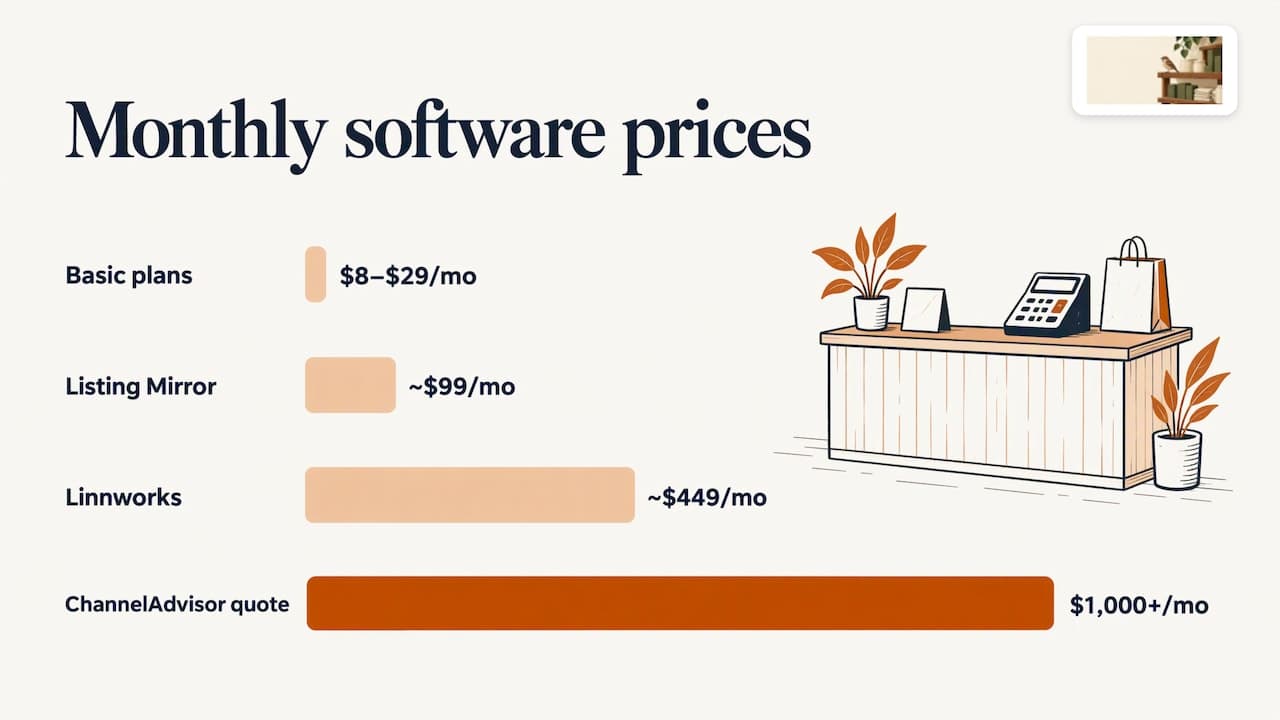
Software pricing is rarely the whole bill. App Compare notes that basic plans run roughly $8 to $29 a month, with costs rising by SKU count or order volume (a SKU is one distinct product or variant you stock). Its 2026 figures also list Listing Mirror from about $99/month, Linnworks around $449/month and ChannelAdvisor at $1,000+/month on custom quotes.
Then add your own time. A tool at $29 a month that costs you three hours of fixing every week is not a $29 tool.
Here is a simple first-year comparison for a small store:
| Route | Year-one cost | Your weekly effort |
|---|---|---|
| ShelfSparrow: audit plus 12 months of watch | $297 + $348 = $645 | Read a daily summary |
| Lydia: audit plus 12 months | $497 + $23,964 = $24,461 | Review its output |
| CRO agency, low end | $1,500+ | Work with the agency |
The ShelfSparrow figure is $297 plus 12 months at $29, which is $348. The Lydia figure is $497 plus 12 months at $1,997, which is $23,964. These are the published prices multiplied out, so confirm current rates with each provider.
One more cost sits beside your software: what you pay to collect each sale. If you are also reviewing your checkout, look at ecommerce payment processing options while you are comparing monthly fees.
How to tell whether automatic fixes are safe
The fear with any automatic fixer is that it changes something it should not. A good system handles this with a confirm-first habit. Guesty’s help-center documentation on its content fixes agent shows the pattern: when a change cannot be confirmed after saving, it is never reported as fixed and stays in the report as waiting for approval. Nothing is silently lost or falsely marked resolved.
That is the standard to expect from anyone fixing your listings. Routine, objective errors (a typo, a dead image link) are safe to correct straight away. Judgment calls such as pricing, brand voice or a rewritten product claim belong in a report for you to decide on.
That is how ShelfSparrow’s audit report works: obvious slips are fixed, and the plain-English, prioritized report tells you what is left and in what order to handle it.
What listing errors cost you
Most listing mistakes fall into a few groups:
- Text errors. Typos in titles and descriptions, wrong sizes or colors.
- Image errors. Broken links, missing photos, wrong image on a variant.
- Search errors. Weak or missing titles and tags that keep shoppers from finding the product.
- Stock errors. Items showing available when sold out, or hidden when you have plenty.
- Consistency errors. The same product described differently on different channels.
Each one sends a shopper to the cleaner store next to yours. Stock errors are the most expensive, because an oversold order means a refund, an apology and sometimes a penalty on the marketplace. Real-time stock sync is the most reliable way to prevent double sales, as CLIMB’s April 2026 guide puts it. For more on this, see our practical guide to managing inventory across channels and how to check product availability against inventory.
If you are choosing between broader categories of tools, our comparisons of product listing management software and ecommerce catalog management software go deeper on the software side.
A different model: hands-off selling
Some services skip tools entirely. CLIMB describes Flyp’s model as connecting sellers with professionals who list, sell and ship for you, at $9/month plus a 5% service fee and a 30 to 50% commission. That is fully hands-off, but it takes a large share of every sale and is built for resale items, not for a store with its own catalog. A flat $29/month watch leaves your margin intact.
How to choose
Use this short list:
- You want listings fixed and kept accurate, with no new dashboard. ShelfSparrow.
- You want a tool and enjoy operating it. A multichannel tool such as Sellbrite.
- You run a $200k to $5M brand and want conversion strategy. An agency such as OptraSeven.
- You want a one-time report and will do the fixing. A freelancer audit or Focused Developer.
For most small stores, number 1 is the answer, because the problem is small, constant and boring. That is precisely the kind of work that gets neglected.
Our view: tidy listings are a habit, not a project
Most store owners we talk about in our work do not have a listing strategy problem. They have a small-things problem. A typo here, a broken photo there, a stock count that stopped matching the shelf. None of it is hard. All of it is easy to put off.
That is why we built ShelfSparrow as a done-for-you service and not another piece of software. Our monitoring keeps a steady eye on your listings and inventory all day, corrects routine errors automatically and highlights low stock. The daily summary tells you what happened in a few lines, so your team can spend its time on bigger decisions.
Start with the $297 audit to clear what is already broken, then keep the $29/month watch so it stays that way. A little order, all day long.
Francis
Start with the audit
If your listings have not had a careful look in a while, the audit is the fastest way to a clean store. We fix typos and broken images within 72 hours and give you a prioritized, plain-English report for everything else. After that, the $29/month watch with listing checks, stock alerts and daily summaries keeps things tidy.
See the store audit for the $297 one-time option, or the Shopify and Etsy listing audit if those are your channels. You can also start at ShelfSparrow.
FAQ
What is the best software to fix listing errors automatically?
For small stores, the best choice is a service that fixes errors rather than listing them. ShelfSparrow corrects routine mistakes like typos and broken images on the spot, and keeps watching for $29/month after a $297 audit. Tools that only flag problems or draft fixes still leave the work with you.
Which listing errors can be fixed automatically?
Objective, routine errors are the safest to fix automatically: typos, broken image links and similar slips. Stock problems can be highlighted automatically so you can reorder in time. Judgment calls, like pricing or product claims, are better handled through a prioritized report.
Does it work outside Shopify and Etsy?
Yes. ShelfSparrow audits any online store or marketplace, including Amazon, Walmart, eBay and WooCommerce. If you sell on several channels, the check also helps keep the same product consistent everywhere.
How is this different from a crosslisting app?
Crosslisting apps help you post and copy listings across marketplaces, mostly for resellers. They are not built to go back and correct mistakes on listings that are already live. A listing-correction service is built for that second job.
Sources
- Best Product Listing Tools for E-Commerce 2026 | App Compare
- Understanding the Airbnb content fixes agent | Guesty Help Center
- How to List Items on Multiple Sites Without Double Sales | CLIMB
- Ecommerce Payment Processing for Online Stores