Best Product Image Monitoring Software for Small Stores
The best way to monitor product images on a small store is to have someone watch the listings and fix what breaks, not to add another tool you have to log into. ShelfSparrow is a done-for-you service, not software: a $297 one-time audit fixes titles, SEO, typos and broken images in 72 hours, and $29 a month keeps listing checks, stock alerts and a daily summary running. Below, we compare it with the other kinds of options small sellers run into, so you can pick based on who ends up doing the work.
TL;DR
- “Image monitoring” means three different things: page-change watchers, image-compliance checkers and done-for-you listing care. Only the last one fixes the problem for you.
- Most tools in this space flag an issue and stop. You still open the listing, find the file and replace it.
- ShelfSparrow costs $297 once for the audit and $29 a month for ongoing checks. Broken images and typos are fixed on the spot.
- Agencies and freelancers can audit your store, but they are usually priced for bigger brands or deliver a report with no monthly watch.
- Pick by one question: do you want an alert, or do you want the image fixed?
Table of Contents
- What product image monitoring actually means
- The three kinds of options
- Where ShelfSparrow fits
- The other names you will meet
- Side-by-side comparison
- How to choose
- Our perspective
- Get the images fixed, not just flagged
- FAQ
- Sources
What product image monitoring actually means
A product image is the photo (or photos) shown on a listing. Monitoring means checking, again and again, that those photos are still there, still load, still show the right product and still meet the rules of the place you sell.
Images go wrong quietly. A theme update changes how photos display. A file gets deleted from your media library. A supplier sends a new version of a product and the old photo now shows the wrong color. Nobody notices until a customer asks why the picture does not match, or until sales on that listing slow down.
If you want the hands-on version of one common failure, our guide to Shopify product images not showing walks through how to find and fix it.
What a good check looks at
Enterprise image-quality systems usually look at four groups of problems. Plain-English versions:
- Technical quality: is the photo big enough, sharp enough and evenly lit?
- Marketplace rules: does it have the background, framing and no-watermark rules the channel asks for?
- Brand consistency: is it the right logo, packaging and variant?
- Match to the listing: does the photo show the product the title and description describe, in the right color?
Small stores rarely need a system built for a retailer with hundreds of thousands of daily visits. They need the basics covered every day: the image loads, it is the right one, and the listing around it is accurate.
The three kinds of options
When you search this keyword, the results are mostly general image recognition platforms (tools that label and sort millions of photos for data science teams) and medical imaging software. Neither is built for a store owner. For a small seller the real choices fall into three groups.
| Type | What it does | Who fixes the problem | Typical cost |
|---|---|---|---|
| Page-change watchers | Check a web page on a schedule and tell you when it changed | You | A few dollars to about $15 a month |
| Image-compliance checkers | Test a photo against marketplace rules (size, background, format) | You, often by editing the file yourself | Free to paid tiers |
| Done-for-you listing care | Audits and watches your listings, fixes errors | The provider | $29 a month plus a $297 audit (ShelfSparrow) |
Page-change watchers
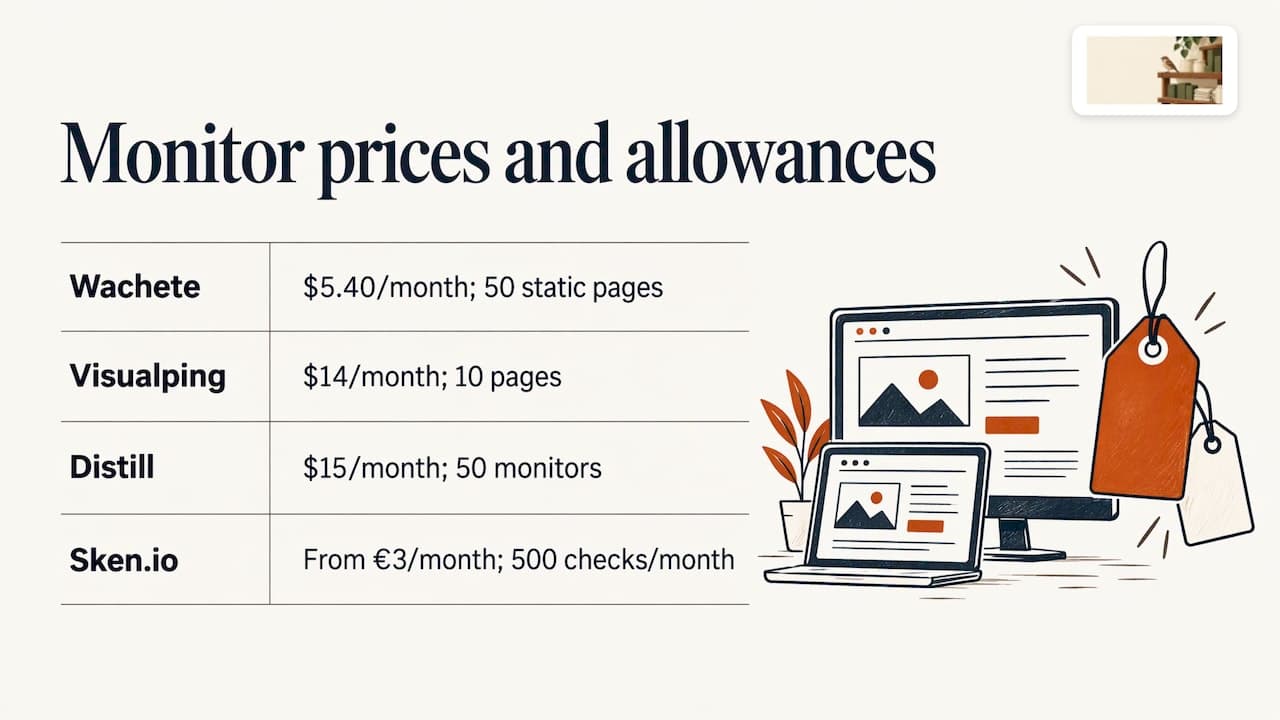
These tools open a web page every so often and alert you if something is different. A September 2026 comparison of website change monitors read prices from vendor sites at the time: Wachete at $5.40 a month for 50 static pages, Visualping at $14 for 10 pages, Distill at $15 for 50 monitors and Sken.io from €3 for 500 checks a month. Prices like these change, so treat them as a snapshot from that month.
They are cheap and fine for watching a competitor’s price page. For your own catalog they have a gap: they tell you “something changed” on a page, not “the main photo of your blue mug is broken.” You still set up each page, read each alert and make the repair.
Image-compliance checkers
These check a photo file against channel rules: dimensions, aspect ratio (the width-to-height shape), file size, format and how much of the background is white. They are handy before you upload. Many are one-image-at-a-time tools, and some checks such as blur or text overlays stay manual. They help you prepare an image, but they do not watch your live store after the photo goes up.
Done-for-you listing care
This is the group ShelfSparrow sits in. Instead of giving you a screen of alerts, we check the listings and fix routine errors. The point is simple: a small store owner does not need more data about broken images. They need the broken images gone.
Where ShelfSparrow fits
ShelfSparrow is a done-for-you store auditing service, not software. You do not learn a dashboard. Here is what is on offer:
- A $297 one-time listing audit. It covers titles, SEO (the wording that helps shoppers and search engines find your products), typos and broken images, and those are fixed in 72 hours. You get a plain-English, prioritized report so you know what was found.
- $29 a month for ongoing care. That is listing checks, stock alerts for low inventory and a daily summary of what happened in your store.
- Monitoring around the clock. Routine listing errors are corrected automatically, and low-stock situations are flagged.
ShelfSparrow works for Shopify and Etsy stores, and we audit any online store or marketplace, including Amazon, Walmart, eBay and WooCommerce.
Broken images are rarely alone. A missing photo often sits beside a typo in the title or a mismatch between the listing and what is in stock. Our guides on checking product details across your listings and checking product availability against inventory show why we look at the whole listing, not the photo alone.
The other names you will meet
Here is how the rest of the field looks when you set it next to ShelfSparrow. Each rival’s price and terms are as that company states them on its own page.
Software tools: Prediko, Sellbrite and StoreClaw
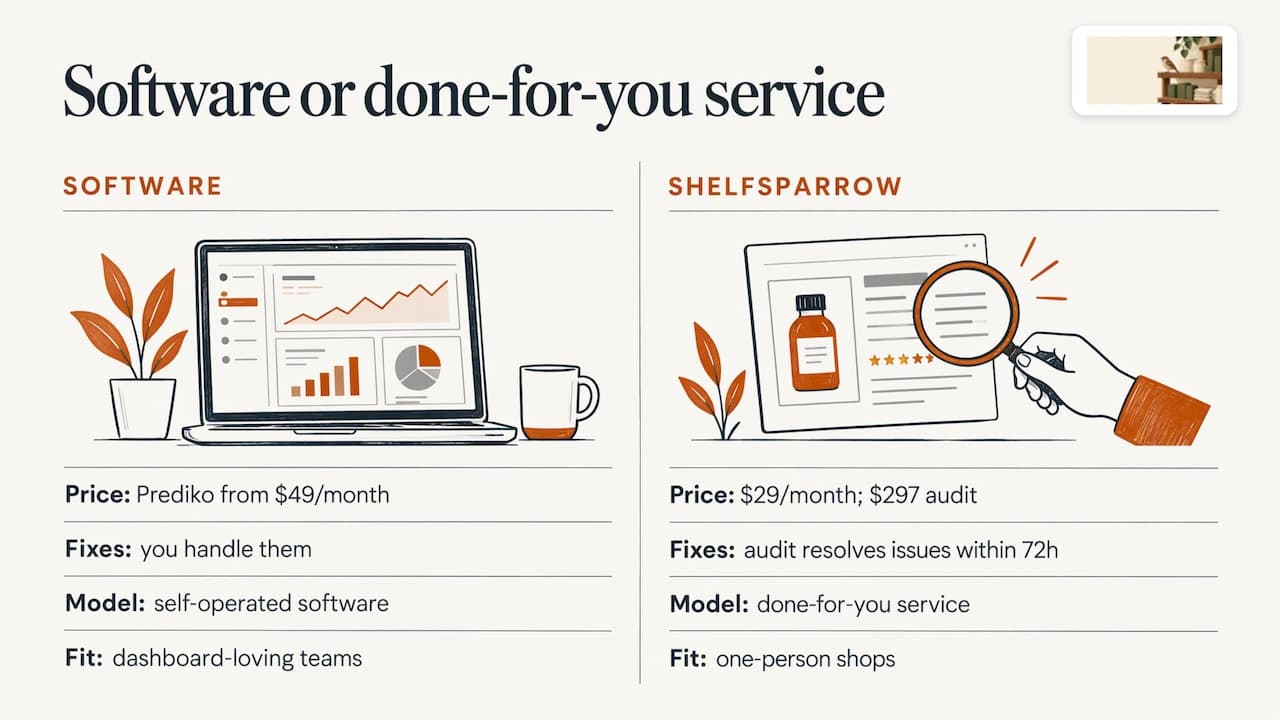
Prediko, Sellbrite and StoreClaw are software you operate yourself. Prediko starts at $49 a month, and the fixing still falls to you. ShelfSparrow watches your store for $29 a month, and the $297 audit fixes what is broken within 72 hours. If you have a team that enjoys living in dashboards, software is a fair fit. If you are a one-person shop packing orders at night, a done-for-you service takes the work off your plate.
We compare more tools in our guides to product listing management software, ecommerce catalog management software and inventory monitoring services.
Lydia
Lydia is the closest branded rival: AI store management for Shopify and Etsy, with audits across 9 categories. Lydia charges $497 for a one-time audit with a report in 48 hours, then $1,997 a month ongoing. ShelfSparrow costs $297 for the audit and $29 a month ongoing, so it undercuts Lydia at both ends. For a small store, that monthly gap is the difference between a tool you keep and one you cancel.
Speechify Boost
Speechify Boost audits your products and drafts fixes (titles, copy, photos, meta) for you to approve, plus a weekly digest. ShelfSparrow fixes issues on the spot, unlike Speechify Boost’s approval-based process. With approval-based work, every fix waits for your click. With ours, a typo or a broken image is simply repaired and you read about it in the daily summary.
OptraSeven
OptraSeven is a Shopify CRO agency (CRO means conversion rate optimization: improving the share of visitors who buy). It offers a deep audit at $149 as a founding offer against a $297 regular price. OptraSeven targets brands doing $200k to $5M a year and has no $29-a-month watchdog offering. If your store is smaller or you want someone to keep watching after the audit, that is a different product from what you need.
Focused Developer
Focused Developer offers a €150 Shopify audit with a report in 5 business days. It offers money back if fewer than 5 fixes are found. It is a report-first model: you receive the findings and then act on them.
Freelancers and agencies
Audit freelancers on Upwork and Fiverr run $35 to $1,299, mostly report-only with no monthly watch. Real CRO agencies charge $1,500 to $3,000 or more. Freelance quality varies widely, and a one-off report starts to go out of date the day after it is delivered, because new products, new photos and new theme changes keep coming.
Side-by-side comparison
| Option | Starting price | Fixes problems for you | Ongoing watch | Built for |
|---|---|---|---|---|
| ShelfSparrow | $297 audit, $29/month | Yes, on the spot | Yes, 24/7 with a daily summary | Small stores on Shopify, Etsy, Amazon, Walmart, eBay, WooCommerce |
| Prediko | $49/month | No, you fix | Software alerts | Teams that run their own tools |
| Lydia | $497 audit, $1,997/month | AI store management | Yes | Shopify and Etsy |
| Speechify Boost | See its site | Drafts fixes for your approval | Weekly digest | Shopify stores |
| OptraSeven | $149 founding offer ($297 regular) | Audit with recommendations | No $29/month offering | Brands at $200k to $5M a year |
| Focused Developer | €150 audit | Report in 5 business days | No | Shopify stores |
| Upwork and Fiverr freelancers | $35 to $1,299 | Mostly report-only | No | Varies |
| CRO agencies | $1,500 to $3,000 or more | Recommendations | Project-based | Larger brands |
How to choose
Five questions settle it for most small stores.
- Who does the repair? An alert is not a fix. If nobody on your team has time to replace images, count the cost of the alert pile.
- How often is the store checked? A weekly digest can miss a broken main photo for six days. Daily or around-the-clock checks catch it sooner.
- Does it cover the whole listing? Images, titles, typos and stock all affect the same sale. A tool that only looks at pictures leaves the rest to you.
- Which channels do you sell on? If you sell on more than one marketplace, you want one provider that covers them all.
- What does it cost over a year? A $29 monthly plan is $348 across twelve months. Compare that with $1,997 a month, or with a one-off report that needs repeating.
AI search is another reason to keep listings tidy. Product pages with accurate, consistent information are easier for assistants to pick up, and that is a field of its own, covered by AI search visibility services. Clean listings are the foundation either way.
A quick worked example
Say you run an Etsy shop with 120 listings. A shop update leaves six main photos not loading and a handful of titles with typos. With a page-change watcher, you might get several alerts, then spend an evening opening listings to work out which are real problems. With the audit, you receive a prioritized report and the fixes arrive within 72 hours. After that, the monthly checks and daily summary mean the next slip is caught early. Our piece on why product photos are not converting covers the photo quality side once the basics work.
Our perspective
Most small store owners do not lose sales to a dramatic failure. They lose them to small things: a photo that stopped loading, a typo in a title, a product showing as available when it is gone. Each one is minor. Together they quietly send shoppers to the cleaner store next to yours.
We built ShelfSparrow around that. A tool that shows you the leak and leaves the repair to you adds one more job to a day that is already full. We would rather keep a steady eye on your listings and fix the routine errors ourselves, so your team can spend its time on products, customers and growth.
That is why we start with a $297 audit that fixes titles, SEO, typos and broken images in 72 hours, then keep watch for $29 a month with stock alerts and a daily summary. A little order, all day long.
Francis
Get the images fixed, not just flagged
If you want your listings checked, fixed and kept accurate, start with the $297 store audit. Titles, SEO, typos and broken images are corrected in 72 hours, and you get a plain-English report that shows what was found and in what order it mattered.
When the audit is done, ShelfSparrow keeps listing checks, stock alerts and a daily summary running for $29 a month. You can also read about our Shopify and Etsy listing audit.
FAQ
What is product image monitoring?
It is the routine checking of the photos on your product listings to make sure they load, show the right item and follow the channel’s rules. Done well, it also covers the text around the photos, because a correct image next to a wrong title still costs sales.
Do I need software to monitor product images?
Not necessarily. Software gives you alerts and leaves the repair to you. A done-for-you service like ShelfSparrow checks the listings and fixes routine errors, so you do not have to learn or open a dashboard.
Does ShelfSparrow work outside Shopify and Etsy?
Yes. We audit any online store or marketplace, including Amazon, Walmart, eBay and WooCommerce. The $297 audit and the $29 monthly care are priced the same way for small sellers wherever they sell.
How fast are broken images fixed?
The $297 audit fixes titles, SEO, typos and broken images within 72 hours. After that, ongoing monitoring runs 24/7, and you read about what was corrected in your daily summary.