Best Ecommerce Catalog Management Software for Small Stores
The best catalog management software depends on what is actually going wrong in your store. If you have thousands of products and many sales channels, a product information management (PIM) tool such as Plytix, Akeneo or Sales Layer is the right class of tool. If you have a small store and want listing errors fixed and stock problems flagged without learning a new dashboard, a done-for-you service like ShelfSparrow fits better. Below, we compare both kinds, with prices, so you can match the tool to the job.
A quick definition first. A catalog is simply the set of product details you show shoppers: titles, descriptions, photos, prices, sizes, stock counts. Catalog management means keeping those details correct and the same everywhere you sell.
TL;DR
- Big catalogs and many channels call for a PIM (product information management) tool: a central database that pushes product data out to every store. Plytix, Akeneo and Sales Layer are the usual names.
- Small Shopify, Etsy, Amazon, Walmart, eBay and WooCommerce sellers often have a different problem: typos, broken images and low stock that nobody has time to check.
- ShelfSparrow is a done-for-you service, not software: a $297 one-time listing audit, fixed in 72 hours, then $29/month for listing checks, stock alerts and daily summaries.
- Software tools give you the system. Services like ours do the fixing. Pick based on whether you want to run a tool or have the work done.
Table of Contents
- What catalog management software actually does
- Three kinds of tools, and which problem each solves
- The main catalog platforms and what they cost
- Multichannel inventory tools: Sellbrite, Prediko and StoreClaw
- Services that audit your listings
- What to check before you choose
- Perspective: why we built a service, not another dashboard
- How ShelfSparrow works
- Ready to have your listings fixed?
- FAQ
- Sources
What catalog management software actually does
Guideflow describes catalog management software as a tool that centralizes product information in a single source of truth and publishes channel-ready data to every store and marketplace you sell through. Typical features include a central product database, bulk import, categories and search, channel-specific publishing, pricing and attribute rules, and AI-assisted writing.
A few terms in plain words:
- PIM (product information management): one master database for product details. You edit once, and every sales channel gets the update.
- SKU: the unique code for one sellable item, for example one shirt in one size and color. Plans are often priced by SKU count.
- API: a connection that lets two programs swap data automatically, such as your PIM and your Shopify store.
- Feed management: formatting your product data so marketplaces and ad platforms accept it.
- Attribute: one product detail, such as material, weight or color.
The same Guideflow team notes that catalog tools overlap heavily with PIM, PXM and feed management. The core job stays the same: take messy product data, clean it once, and keep every channel aligned.
Three kinds of tools, and which problem each solves
Most “best of” lists mix very different products. It helps to separate them.
| Type | Best for | Typical examples | Who does the work |
|---|---|---|---|
| PIM / catalog platform | Large or complex catalogs, wholesale, many languages | Plytix, Akeneo, Sales Layer, Salsify | You or your team |
| Multichannel inventory platform | Syncing stock and listings across marketplaces | Sellbrite, Prediko | You, with alerts |
| Done-for-you listing care | Small stores that want errors fixed, not another system | ShelfSparrow | We do |
If you also need a plugin for WooCommerce stock monitoring, you are in the second column: the question is how quickly the tool tells you stock is low, and whether it fixes anything on its own.
The main catalog platforms and what they cost
Intellect Outsource’s 2026 comparison lists Akeneo, Sales Layer, Plytix, Productsup, Pimcore, DataFeedWatch, Salsify and ChannelEngine as leading catalog platforms. It adds that the right pick depends on product count, budget and where you sell.
Plytix
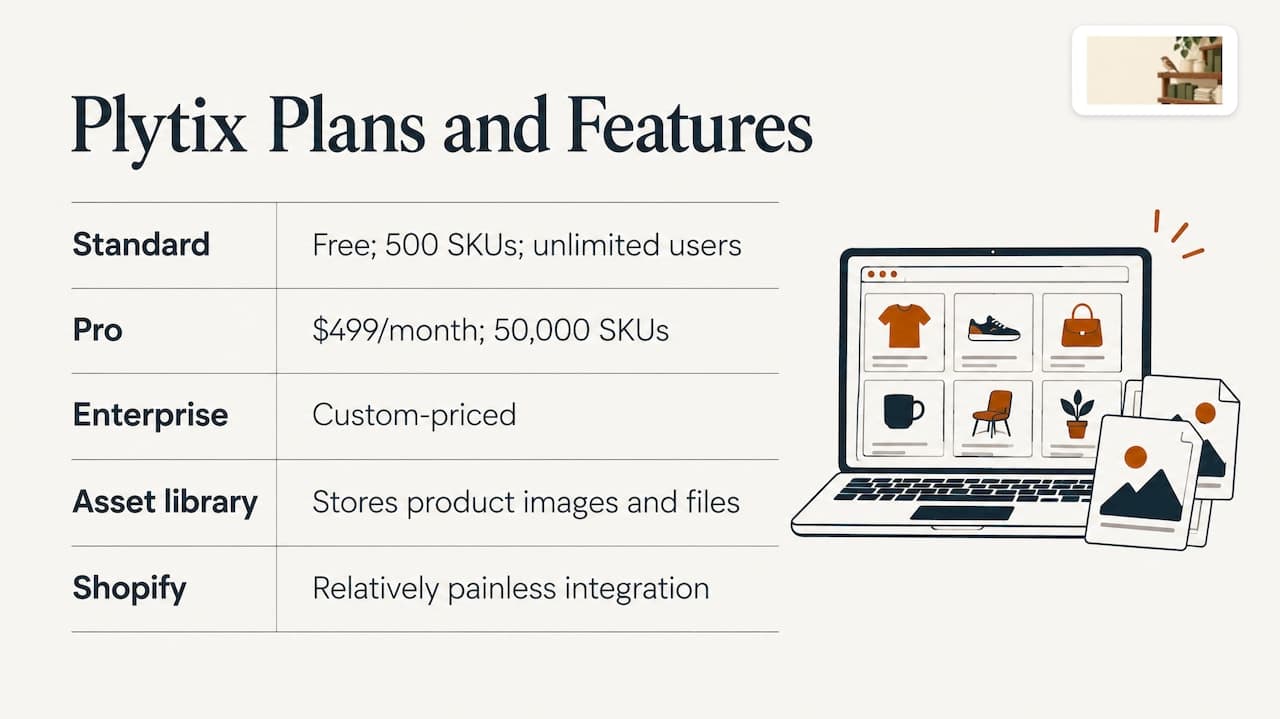
Plytix combines product information management with digital asset storage (a library for your product images and files). Its Standard plan is free for 500 SKUs with unlimited users, and the Pro plan is $499/month for 50,000 SKUs. Enterprise is custom-priced. Ecommerce Times reports that merchants value its wholesale catalog workflows and relatively painless Shopify integration.
Fit: a store with a few hundred products that wants a free central database, or a brand selling wholesale that needs polished product sheets.
Sales Layer
Sales Layer has four plans with custom pricing. According to a pricing review, the Scale plan supports up to 10,000 SKUs and 5 users, and Premium adds up to 50,000 SKUs, more languages, and Shopify, BigCommerce and Amazon connectors.
Fit: growing brands with several languages and many users. You will need a sales conversation to get a price.
Akeneo
Akeneo’s Community Edition is free and open source, but one review says it needs your own server and PHP/MySQL knowledge. The same review says it is often too big for catalogs under 1,000 products, and that its higher tiers are quote-only.
Fit: teams with developers who want full control.
Salsify, DataFeedWatch and others
Ecommerce Times puts Salsify’s midmarket entry point at typically $2,000+ a month, and says pure feed tools like DataFeedWatch cost less than Plytix. These are built for larger brands, not a one-person Etsy shop.
Multichannel inventory tools: Sellbrite, Prediko and StoreClaw
If your main worry is stock counts across Shopify, Etsy, Amazon, Walmart and eBay, you are looking at a different tool class. These platforms connect your channels and sync quantities so you do not oversell.
- Sellbrite is a multichannel listing and inventory tool. It gives you the system; you still run it. If you are weighing it, our guide to Sellbrite alternatives for small sellers lays out the options.
- Prediko starts at $49 a month and focuses on inventory planning, but the fixing is still left to you.
- StoreClaw is another store-management competitor in this space.
All three are software: you log in, read the data, and act. That suits sellers who enjoy the operations side. It suits less well a seller who already feels buried in tabs.
Services that audit your listings
An audit looks at each product page and reports what is wrong: weak titles, missing keywords, typos, broken images. Prices vary a lot, and so does what you get back.
| Provider | What it offers | Price | Notes |
|---|---|---|---|
| ShelfSparrow | Listing audit covering titles, SEO, typos and broken images, fixed in 72 hours; then ongoing monitoring | $297 one-time, then $29/month | Fixes issues on the spot; works on any store or marketplace |
| Lydia | AI store management for Shopify and Etsy, audits across 9 categories | $497 one-time audit, report in 48 hours, then $1,997/month | Ongoing plan costs far more |
| Speechify Boost | Audits products and drafts fixes (titles, copy, photos, meta) for you to approve, plus a weekly digest | See the provider | Approval-based process |
| OptraSeven | Shopify conversion rate optimization (CRO) agency, deep audit | $149 founding offer against a $297 regular price | Targets brands doing $200k to $5M a year; no $29/month watchdog offering |
| Focused Developer | Shopify audit with report in 5 business days | €150 | Money back if fewer than 5 fixes are found |
| Upwork and Fiverr freelancers | Audit gigs | $35 to $1,299 | Mostly report-only, no monthly watch |
| CRO agencies | Full conversion optimization | $1,500 to $3,000 or more | Built for larger budgets |
Two plain-word notes. CRO means conversion rate optimization: changing your pages so more visitors buy. Meta means the title and description shown in search results.
The pattern is clear. Most audits end with a document and leave the work to you. Speechify Boost drafts fixes, but you approve each one. We fix issues on the spot, and we cost $297 for the audit and $29/month ongoing, which undercuts Lydia at $497 and $1,997/month.
What to check before you choose
Use these questions to decide between a catalog platform, an inventory tool, a WooCommerce plugin or a service.
- How many products do you have? Under a few hundred, a full PIM is usually more system than you need. Plytix’s free tier covers 500 SKUs if you want one anyway.
- Where do you sell? Etsy and Shopify sellers, Amazon and Walmart sellers, and WooCommerce store owners each need different connections. Confirm the tool supports your exact channels before paying.
- Who will do the work? Software needs someone to log in, review and act. If that person is you, add up the weekly hours.
- What does fixing cost? A report that lists 40 problems is only useful if someone corrects them.
- What is the real monthly cost? Compare the base plan with what you will pay at your catalog size. Several platforms price by SKU count or by quote.
- Does it watch stock? Out-of-stock items still shown as available lead to cancelled orders and unhappy buyers. Our guide to checking product availability against inventory covers a simple routine.
For WooCommerce stores, apply the same test to any low-stock plugin: does it only send an email, or does something happen next? A plugin that alerts you still leaves the restock and the listing update to you. Check the plugin’s own page for the channels and notification options it supports.
Perspective: why we built a service, not another dashboard
We talk to small store owners every week. Almost none of them lack a tool. They lack time. A typo in a title sits there for months. A broken image slips in after a theme update. A best seller runs low and nobody notices until the order comes in.
That is why ShelfSparrow is a done-for-you service, not software. You do not learn a new system. We keep a steady eye on your listings and inventory, 24/7, correct routine errors, and flag low stock. Each day you get a short summary in plain English.
A catalog platform is a good answer when you have a huge catalog and a team to run it. For a small seller who wants leaks fixed, we think a $297 audit followed by $29/month of quiet watching is the calmer path. A little order, all day long.
Francis
How ShelfSparrow works
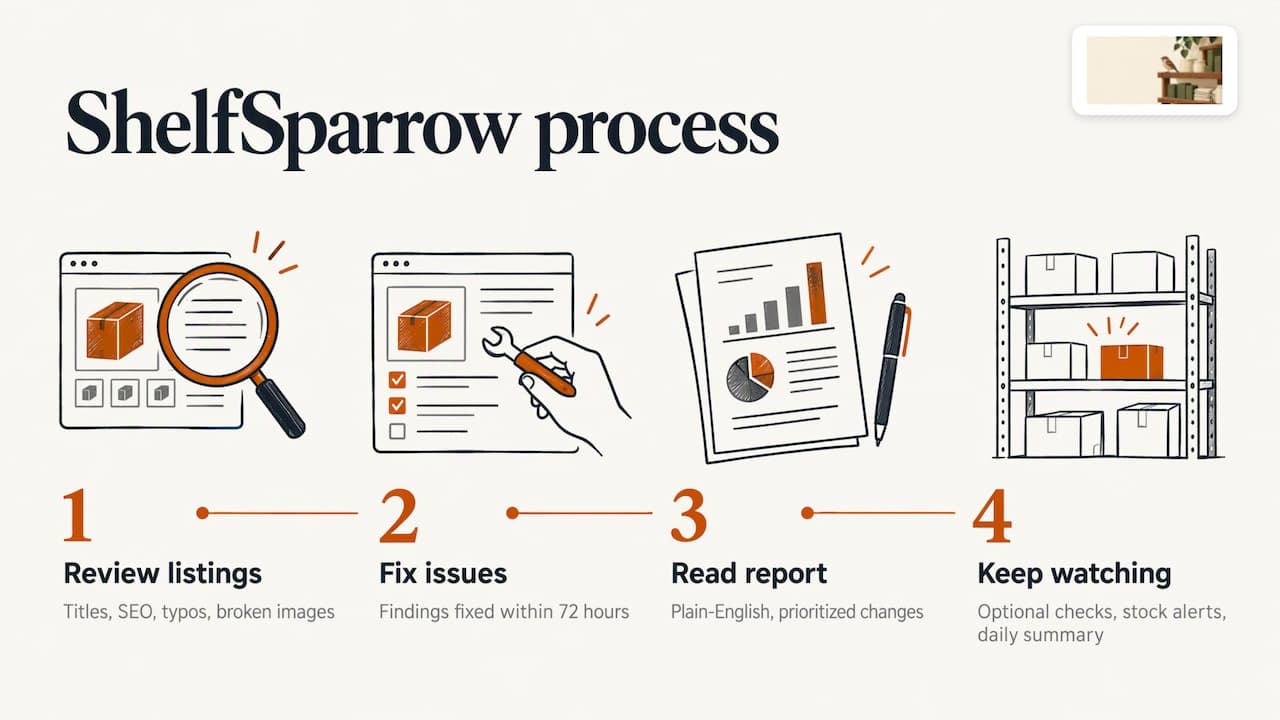
We start with the audit. For $297 one time, we review your listings for titles, SEO, typos and broken images, then fix what we find within 72 hours. You also get a plain-English, prioritized report so you know what changed and what matters most.
Then, if you want it, we keep watching. For $29/month you get listing checks, stock alerts and a daily summary. Routine errors are corrected automatically. Low-stock situations are highlighted, so your team can focus on bigger work.
We work with Shopify and Etsy, and we audit any online store or marketplace, including Amazon, Walmart, eBay and WooCommerce.
Ready to have your listings fixed?
If your catalog is small and your time is short, start with the audit. We look at every listing, fix the small things on the spot and hand you a clear list of what is left. Then the monthly watch keeps it tidy.
See the store audit for the details, or read about our Shopify and Etsy listing audit. Want to know what we usually find first? Start with five listing mistakes that hurt Shopify sales and our product detail consistency checklist. Etsy sellers can also use the Etsy listing SEO checklist. To see everything in one place, visit the ShelfSparrow home page.
FAQ
What is the best catalog management software for a small store?
For a few hundred products, a free tier such as Plytix’s 500-SKU Standard plan gives you a central database at no cost. If you would rather not run a system at all, ShelfSparrow handles the checking and fixing for $29/month after a $297 audit. The right choice depends on whether you want a tool or the work done.
Do I need a PIM for Shopify or Etsy?
Usually not at small scale. A PIM keeps product data in one place and pushes it to many channels, which pays off with large catalogs, many languages or wholesale. A store with one main channel and a modest catalog often gains more from regular listing checks and fast fixes.
How is a listing audit different from catalog software?
Software is a system you operate. An audit is a review of your actual listings. Many audits end with a report only. Ours fixes titles, typos and broken images within 72 hours and includes a prioritized report.
Can ShelfSparrow work with Amazon, Walmart, eBay or WooCommerce?
Yes. We audit any online store or marketplace, including Amazon, Walmart, eBay and WooCommerce. Our monitoring is built around Shopify and Etsy, so tell us where you sell and we will confirm what we cover.
How much do audits and monitoring cost?
Our audit is $297 one time and monitoring is $29/month. Lydia charges $497 for an audit and $1,997/month ongoing. Freelance audits on Upwork and Fiverr run $35 to $1,299, and CRO agencies charge $1,500 to $3,000 or more.
Sources
- Guideflow: 8 best catalog management software for 2026
- Intellect Outsource: Best Catalog Management Platforms for Ecommerce in 2026
- Plytix pricing (2026)
- Ecommerce Times: Plytix in 2026
- Sales Layer Pricing 2026
- Akeneo Product Cloud overview