Inventory Monitoring Services Compared for Small Online Stores

For a small store, the best inventory monitoring service is one that watches your listings and stock around the clock and fixes what it finds, so you don’t have to learn another dashboard. ShelfSparrow does that as a done-for-you service: a $297 one-time listing audit, then $29 a month for listing checks, stock alerts and a daily summary. Below, we compare it with the other options sellers run into, so you can choose with the prices side by side.
TL;DR
- Inventory monitoring means keeping a steady eye on your stock counts and on the listings that sell that stock, so errors and stockouts get caught early.
- Most tools alert you or hand you a report. ShelfSparrow is a service, not software: it fixes routine issues such as typos and broken images, and flags low stock.
- ShelfSparrow costs $297 once for the audit (fixes within 72 hours) and $29 a month for ongoing checks, stock alerts and daily summaries.
- Rivals range from a $49-a-month planning tool to a $1,997-a-month AI service and agencies at $1,500 to $3,000 or more.
- It covers any online store or marketplace: Shopify, Etsy, Amazon, Walmart, eBay and WooCommerce.
Table of Contents
- What inventory monitoring actually is
- How automated monitoring works
- What to compare before you pick a service
- The options side by side
- What gets fixed and what gets flagged
- What a month looks like with the $29 plan
- Perspective
- Start with the audit
- FAQ
- Sources
What inventory monitoring actually is
Inventory monitoring is the routine of checking how much stock you have and whether your listings match it. Shopify describes inventory management as tracking products through receiving, storage, selling, delivery, reordering and returns, and its admin updates quantities automatically when orders are placed. That covers counting. Monitoring is the part that comes after: someone, or something, looking at the numbers every day and noticing when they are wrong.
For a small store, there are two kinds of problems to watch.
Stock problems. A best seller is down to three units. A product shows as available on Etsy but is sold out on your own site. Counts drift apart across channels (the places you sell, such as your own store and a marketplace).
Listing problems. A listing is the product page a shopper sees. Typos in a title, a broken image, a missing description or a weak search title (the words shoppers type to find you) quietly cost sales. Nothing crashes. Shoppers just scroll past, or buy from the tidier store next to yours.
Good monitoring covers both, because a listing that is perfect but out of stock still loses the sale, and a full shelf with a broken photo loses it too.
How automated monitoring works
Automated monitoring means software or a service checks your store on a schedule instead of you doing it by hand. In plain terms, it does four things:
- Reads your products and counts. It connects to your store or marketplace account and pulls the current listings and quantities.
- Compares them to rules. A rule might be “flag any product with fewer than 10 units” or “flag any listing with an image that won’t load.”
- Raises a flag. The flag goes to you as an alert, an entry in a report, or a daily summary.
- Fixes it, or waits for you. This is where services differ most. Some only tell you. Some draft a fix and wait for your approval. ShelfSparrow corrects routine errors on the spot.
The low-stock rule is the one most owners set first. A common way to pick the number is the reorder point: Shopify’s guide says to multiply your average daily sales by your supplier’s lead time, the days between ordering and receiving. Its example is 10 daily sales times 15 days, or 150 units. If you sell 10 a day and restocking takes 15 days, an alert at 150 units gives you time to reorder before you run out. Our guide to setting low-stock alert thresholds walks through choosing that level for your own store.
Stock accuracy is also only half of a smooth sale. The other half is checkout, which is why sellers in restricted or high-risk categories look at payment processing for online stores at the same time they tidy their inventory.
What to compare before you pick a service
Price matters, but five questions separate the options more than any feature list.
- Does it fix, or only report? A report tells you what is wrong. You still have to do the work. For a one-person shop, the work is the problem.
- Which stores does it cover? Some tools watch one marketplace only. Others sync stock but never look at listing quality.
- How often does it check? Hourly, every few hours, or once a day. For fast sellers, slow checks mean overselling in between.
- What does it ask of you? Another dashboard, a weekly review, approvals on every change.
- What does it cost over a year? A $29 plan and a $1,997 plan are different decisions, not different versions of the same one.
The options side by side
Here is how the services we run into most compare. Prices are as each provider states them; check their own pages for current terms.
| Option | What it is | One-time audit | Ongoing | Fixes issues? |
|---|---|---|---|---|
| ShelfSparrow | Done-for-you service, any store or marketplace | $297, fixes in 72 hours | $29/month | Yes, on the spot |
| Lydia | AI store management for Shopify and Etsy, audits across 9 categories | $497, report in 48 hours | $1,997/month | Report and ongoing management |
| Speechify Boost | Audits products, drafts fixes for approval | Not stated here | Weekly digest | Drafts, you approve |
| OptraSeven | Shopify CRO agency | $149 founding offer, $297 regular | No $29/month watch | Agency deep audit |
| Focused Developer | Shopify audit | €150, report in 5 business days | None stated | Report |
| Upwork and Fiverr freelancers | Audit freelancers | $35 to $1,299 | Mostly none | Mostly report-only |
| CRO agencies | Conversion rate optimization (making more visitors buy) | $1,500 to $3,000 or more | Varies | Recommendations |
| Prediko | Inventory planning tool | None | From $49/month | You do the fixing |
ShelfSparrow: the pick for small stores that want leaks fixed
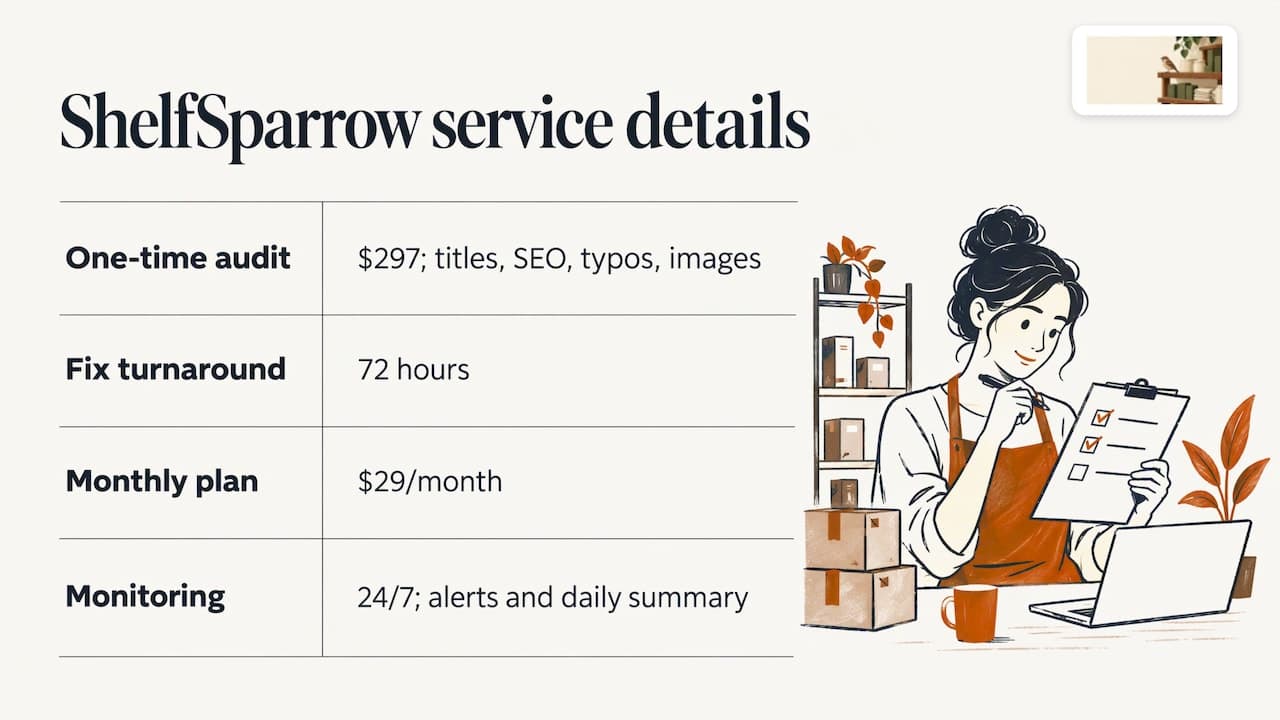
ShelfSparrow is a done-for-you store auditing and monitoring service, not software. The one-time listing audit costs $297 and covers titles, SEO (how easily shoppers find your listing in search), typos and broken images, with fixes made in 72 hours. You get a plain-English report that puts the biggest problems first.
Then the monthly plan takes over. For $29 a month, ShelfSparrow runs listing checks, sends stock alerts and delivers a daily summary. Monitoring runs 24/7 and routine errors are corrected automatically. The summary tells you what was caught and what needs a decision, so you read one short note instead of opening five admin screens.
It works for any online store or marketplace, including Shopify, Etsy, Amazon, Walmart, eBay and WooCommerce. That matters if you sell on more than one channel, since a stock problem on one often shows up as a bad listing on another. For the cross-channel side, see our practical guide to managing inventory across channels.
Lydia: AI management at agency prices
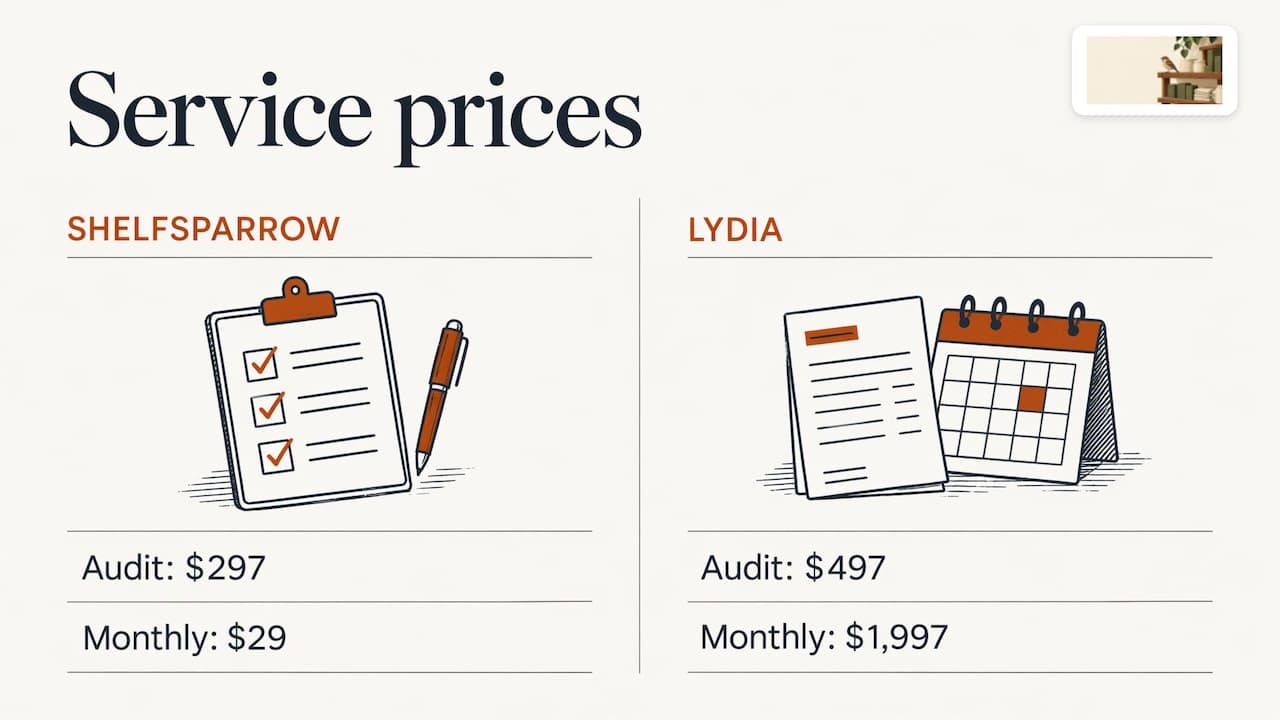
Lydia is a branded rival offering AI store management for Shopify and Etsy, with audits across 9 categories. It charges $497 for a one-time audit with a report in 48 hours, then $1,997 a month ongoing. ShelfSparrow undercuts it at both ends: $297 for the audit and $29 a month after that. For a store that sells a few hundred orders a month, the gap between $29 and $1,997 is the whole decision.
Speechify Boost: drafts for your approval
Speechify Boost audits your products and drafts fixes for titles, copy, photos and meta (the short description search engines show under your link), plus a weekly digest. Every change waits for you to approve it. ShelfSparrow fixes issues on the spot, so the work is done by the time you read the daily summary rather than sitting in a queue.
OptraSeven and Focused Developer: audits without a watch
OptraSeven is a Shopify CRO agency. It offers a deep audit at $149 as a founding offer against a $297 regular price. It targets brands doing $200k to $5M a year and has no $29-a-month watchdog offering. Focused Developer offers a €150 Shopify audit with a report in 5 business days, and it offers money back if fewer than 5 fixes are found. Both are audits. Neither keeps watching your store afterward.
Freelancers and agencies
Audit freelancers on Upwork and Fiverr run from $35 to $1,299. Most deliver a report and stop, with no monthly watch. Real CRO agencies charge $1,500 to $3,000 or more. That is a fair fit for large brands. A store with a handful of products usually needs the leaks fixed and kept fixed, which is what a $297 audit plus $29 a month is built to do.
Prediko, Sellbrite and StoreClaw: tools you operate yourself
Prediko, Sellbrite and StoreClaw are software competitors in the wider space. Prediko starts at $49 a month and still leaves the fixing to you. Sellbrite is built around listing and syncing inventory across marketplaces. These tools are strong when you want to run the numbers yourself. If you want someone else to catch and correct the problem, a service is the better shape. ShelfSparrow watches your store for $29 a month, and the $297 audit fixes what is broken in 72 hours.
Marketplace-specific trackers
Some tools watch only one marketplace. SellerSonar, for example, monitors Amazon listings, Buy Box (the box that decides whose offer the Add to Cart button uses), reviews and keyword ranks across 23 Amazon marketplaces. Its Pro plan is $19.98 a month on annual billing for 150 ASINs (Amazon’s product IDs) with checks every 4 hours, and its higher plans check every 2 hours and hourly. That suits an Amazon-only seller who wants competitor tracking. If you sell on several channels and want errors corrected, not just flagged, you need coverage beyond one marketplace.
What gets fixed and what gets flagged
It helps to know which problems a good service handles by itself and which it should pass to you.
Fixed automatically (routine errors):
- Typos in titles and descriptions
- Broken or missing images
- Basic title and SEO clean-up found in the audit
Flagged for you (decisions):
- Low stock on a product, so you can reorder
- Inventory counts that don’t match across channels
- Anything that needs a business choice, such as a price change
The split is deliberate. Stock levels are your call, because only you know your supplier, your cash and your season. Typos and broken images are not a judgment call. Nobody wants to approve a fix for a misspelled word. That is why a service that fixes the small things and flags the big ones saves the most time. Our guide to low stock alerts and how to stop stockouts covers the flagged side in more detail, and checking product availability against inventory shows what a mismatch looks like.
What a month looks like with the $29 plan
Picture a Shopify and Etsy shop with 120 products. On day one, the audit finds a handful of typos, some broken images and a few weak titles. Those get fixed within 72 hours, and you get the plain-English report listing what else deserves attention, biggest issues first.
From then on, you get one daily summary. Most days it says everything is in order. Some days it says a product is running low and the rest is handled. You reorder the product, and you are back to work on things only you can do. That is the “little order, all day long” idea: not a dramatic fix, a steady one.
Perspective
We built ShelfSparrow for the owner who knows exactly what is wrong with the store and has no hour left to fix it. Typos, a photo that stopped loading, a bestseller with four units left. None of it is hard. All of it gets skipped when the day fills up.
That is why we run it as a service, not software. Another dashboard is another thing to check, and a small team already has plenty. We keep a steady eye on your listings and stock, correct the routine errors, and send one daily summary so you know where things stand.
The audit comes first, at $297, because a clean starting point makes the monitoring work better. Then $29 a month keeps it that way. We think a store should be able to stay tidy without a big tool budget or a long approval queue.
Francis
Start with the audit
If your listings haven’t had a proper check in a while, the audit is the quickest way to see what is leaking sales. ShelfSparrow’s $297 store audit fixes titles, SEO, typos and broken images in 72 hours and gives you a prioritized, plain-English report. After that, the $29-a-month plan adds listing checks, stock alerts and the daily summary. You can see how it works for your channels on the Shopify and Etsy listing audit page.
If you also keep your routine tidy on the store side, our Shopify store maintenance routine is a good companion.
FAQ
What is an inventory monitoring service?
It is a service that regularly checks your stock counts and your product listings, then alerts you or fixes problems. Basic tools only count stock. A fuller service also looks for listing errors, since those cost sales just as a stockout does.
How often should inventory be checked?
As often as your sales pace requires. A store selling 10 units a day can run out in days, so daily checks are a sensible minimum. ShelfSparrow monitors 24/7 and sends a daily summary, so you see the result once a day without checking yourself.
Do I need software to monitor inventory?
Not necessarily. Software gives you a tool to operate. A done-for-you service does the checking and fixing for you. ShelfSparrow is a service, so there is no new dashboard to learn.
Does ShelfSparrow work outside Shopify and Etsy?
Yes. It audits any online store or marketplace, including Amazon, Walmart, eBay and WooCommerce. The audit is $297 one time and the ongoing plan is $29 a month.
Sources
- Shopify Help Center: Understanding inventory management
- Shopify: What Are Inventory Levels?
- SellerSonar Review 2026