Best Ecommerce Inventory Monitoring Software for 2026

If you run a small Shopify, Etsy, Amazon, Walmart, eBay or WooCommerce store, the best inventory monitoring is the kind that fixes problems, not the kind that shows you another chart. ShelfSparrow is a done-for-you service, not software: a $297 one-time listing audit, then $29 a month for listing checks, stock alerts and a daily summary. Below, we compare it with the tools and services small sellers most often shortlist, so you can see what each one watches, what it costs and who does the work.
TL;DR
- Monitoring means something watches your listings and stock levels all day and tells you when something slips. The real question is who fixes it.
- Most software tools alert you and leave the fix to you. ShelfSparrow’s $29/month service pairs listing checks and stock alerts with a daily summary, and its $297 audit fixes titles, SEO, typos and broken images within 72 hours.
- Audit-only offers (agencies, freelancers, one-off reports) are priced from $35 to $3,000 or more, and mostly stop at a report with no monthly watch.
- Pick by how much time you want to spend inside a dashboard. If the answer is “none,” choose a service that does the work.
Table of Contents
- What “inventory monitoring” actually covers
- How to compare your options
- The options at a glance
- ShelfSparrow: monitoring that fixes as it goes
- Sellbrite: multichannel sync for sellers who want to run the tool
- Prediko and StoreClaw: software you operate
- Lydia: broad AI management at a much higher price
- Speechify Boost: drafts fixes, then waits for you
- Audit-only offers: useful snapshots, no monitoring
- Which one fits your store
- Get the leaks fixed
- What good monitoring should catch
- A worked example: the cost of one quiet leak
- Our view
- FAQ
- Sources
What “inventory monitoring” actually covers
The phrase gets used for three different jobs. Knowing which one you need saves you from paying for the wrong one.
Stock monitoring. Watching how many units you have and warning you before an item runs out. A reorder point is the stock level at which you should order more. A low-stock alert is the message that fires when an item reaches it. Our guide on preventing inventory stockouts in a small online store shows how to set those levels.
Listing monitoring. Watching the pages customers actually see: titles, descriptions, photos, prices and whether an item shows as available. A listing is simply one product’s page on your store or marketplace. Typos, a broken image or an item showing “in stock” when the shelf is empty all cost sales quietly.
Operations monitoring. A daily or weekly roundup of what changed and what needs attention, so you are not checking five tabs each morning.
Most “inventory software” does the first job well. Few do the second, and fewer still fix anything. That gap is where small stores lose money without noticing: a shopper lands on your page, sees a blurry or missing photo and a typo in the title, and buys from the cleaner store next to yours.
How to compare your options
Five questions sort the field quickly.
- What does it watch? Stock only, listings only, or both.
- Where does it watch? Shopify and Etsy only, or also Amazon, Walmart, eBay and WooCommerce.
- What happens when it finds a problem? It alerts you, it drafts a fix for you to approve, or it fixes the issue.
- Who learns the tool? A dashboard (the screen of charts and settings you log into) needs setup and regular attention. A service that sends a summary does not.
- What is the total monthly cost? Include the one-time audit or setup, not just the subscription line.
Small teams tend to care most about questions 3 and 4. If you have no operations hire, every alert that waits for you to act is another task on a list that already runs long.
The options at a glance
Prices below are as each provider publishes them, and they change, so confirm on the provider’s own page before you buy.
| Option | Type | What it covers | Published price | Who fixes issues |
|---|---|---|---|---|
| ShelfSparrow | Done-for-you service | Listing checks, stock alerts, daily summary; audit of titles, SEO, typos, broken images | $297 one-time audit, $29/month ongoing | We do, on the spot |
| Sellbrite | Software | Multichannel inventory sync, alerts, catalog and order tools | Forever Free; Pro plans from $29/month | You |
| Prediko | Software | Inventory planning and alerts for Shopify | From $49/month | You |
| StoreClaw | Software | Store management tooling | Check its own page | You |
| Lydia | AI store management | Audits across 9 categories for Shopify and Etsy | $497 one-time audit (report in 48 hours), then $1,997/month | Ongoing plan |
| Speechify Boost | Audit and drafting tool | Audits products, drafts fixes for titles, copy, photos and meta, weekly digest | Check its own page | Drafts; you approve |
| OptraSeven | Shopify CRO agency | Deep conversion audit | $149 founding offer, $297 regular | Report |
| Focused Developer | Shopify audit | Audit with report in 5 business days | €150 | Report |
| Upwork and Fiverr freelancers | Marketplace | Audits of varying depth | $35 to $1,299 | Mostly report only |
| CRO agencies | Agency | Conversion rate optimization | $1,500 to $3,000 or more | Varies |
CRO stands for conversion rate optimization: improving the share of visitors who buy.
ShelfSparrow: monitoring that fixes as it goes
ShelfSparrow is a done-for-you store auditing and monitoring service, not software. There is no dashboard to learn. It is built for small sellers who want leaks fixed rather than charted.
It works in two parts.
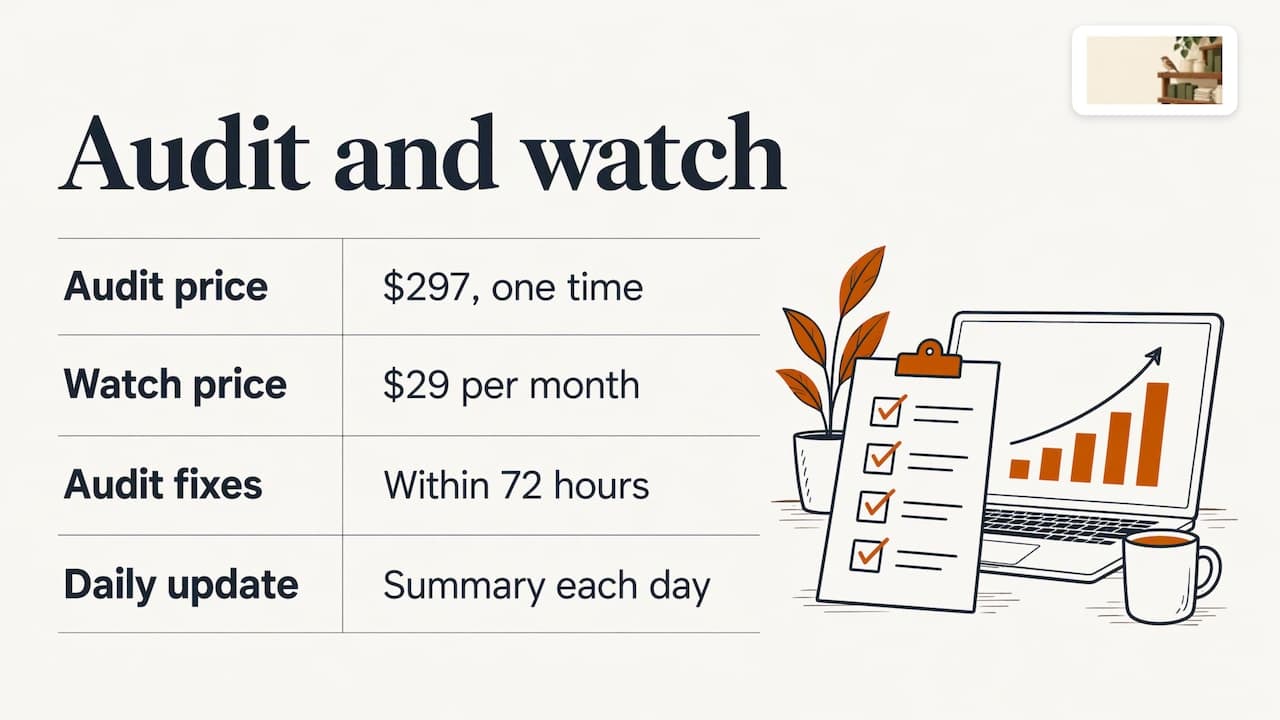
The audit: $297, one time. A store audit covers titles, SEO (the wording that helps shoppers and search engines find a product), typos and broken images, and we fix them within 72 hours. You get a plain-English, prioritized report, so you can see what was wrong and what matters most. Details for the two biggest platforms are on the Shopify and Etsy listing audit page.
The watch: $29 a month. After the audit, ShelfSparrow keeps a steady eye on your store around the clock. It runs listing checks, sends stock alerts when something runs low, corrects routine listing errors automatically, and sends a daily summary so you know where things stand in a couple of minutes.
It works with any online store or marketplace, including Shopify, Etsy, Amazon, Walmart, eBay and WooCommerce.
That combination is the point. Monitoring that only alerts creates a to-do list. Monitoring that corrects routine issues and tells you about the rest creates a calmer morning.
Sellbrite: multichannel sync for sellers who want to run the tool
Sellbrite is a cloud inventory product for small and midsize sellers. According to its SoftwareAdvice profile, it synchronizes inventory across listings in real time and includes alerts and notifications, catalog management, reporting and marketplace integration.
The same profile lists a Forever Free tier, Pro 100 at $29 a month, Pro 500 at $79 a month and Pro 2K at $179 a month, billed monthly, with a 30-day unlimited trial of Pro 100 and no credit card required. Those figures are the 2026 listing, so check the live pricing page before you commit.
Sellbrite suits a seller who wants to manage channels in one screen and is comfortable doing the setup and the follow-up. If you would rather hand the checking and fixing to someone else, the $29 monthly ShelfSparrow service covers that, with the audit fixing what is already broken. For a longer list of tools in that family, see our Sellbrite alternatives roundup.
Prediko and StoreClaw: software you operate
Prediko is a Shopify inventory planning tool that starts at $49 a month. It is aimed at forecasting and reordering, and you act on what it shows. At $49, it costs $20 more per month than ShelfSparrow’s $29 watch, and it does not take the fixing off your plate.
StoreClaw is another name that comes up on small-store shortlists. As with any software, ask what it checks, which channels it connects to and what it does once it spots a problem.
The common thread: these are tools. A tool is only as good as the time you give it. A store owner who is packing orders, answering customers and sourcing stock often does not have an hour a day to babysit a dashboard.
Lydia: broad AI management at a much higher price
Lydia positions itself as AI store management for Shopify and Etsy, with audits across 9 categories. It charges $497 for a one-time audit with a report in 48 hours, then $1,997 a month ongoing.
ShelfSparrow’s numbers sit well below both ends: $297 for the audit and $29 a month ongoing. For a small store, the gap between $29 and $1,997 a month is the difference between a small line item and a payroll decision.
Speechify Boost: drafts fixes, then waits for you
Speechify Boost audits your products and drafts fixes for titles, copy, photos and meta (the title and description search engines show in results), plus a weekly digest of what it found.
The workflow is approval-based: it proposes, you review and approve. ShelfSparrow fixes issues on the spot. If you want a draft to edit, the first model fits. If you want the typo gone and the broken image replaced while you are busy shipping orders, the second saves you the review queue.
Audit-only offers: useful snapshots, no monitoring
Some sellers start with a one-time audit from an agency or freelancer. These are worth understanding because they are priced very differently.
- OptraSeven, a Shopify CRO agency, offers a deep audit at $149 as a founding offer against a $297 regular price. It targets brands doing $200k to $5M a year and has no $29 a month watchdog offering.
- Focused Developer offers a €150 Shopify audit with a report in 5 business days, and gives money back if fewer than 5 fixes are found.
- Upwork and Fiverr freelancers run from $35 to $1,299 for audits, mostly report only, with no monthly watch.
- Real CRO agencies charge $1,500 to $3,000 or more.
A report tells you what is wrong. It does not make the change, and it does not notice the next problem next month. A ShelfSparrow audit at $297 arrives with the fixes made within 72 hours, and the $29 monthly service keeps watching afterward, so the store you pay to tidy once stays tidy.
Which one fits your store
| If you… | Choose |
|---|---|
| Want listings and stock watched and fixed without learning a dashboard | ShelfSparrow |
| Sell on Shopify, Etsy, Amazon, Walmart, eBay or WooCommerce and want one provider for all | ShelfSparrow |
| Have broken images, typos or weak titles right now | ShelfSparrow’s $297 audit |
| Want to run a multichannel sync tool yourself | Sellbrite |
| Want planning and forecasting software for Shopify | Prediko |
| Run a $200k to $5M brand wanting a conversion deep dive | An agency audit such as OptraSeven |
We recommend ShelfSparrow first for most small sellers because the reader of this article is usually one person doing the work of five. The right tool for that person removes tasks.
Get the leaks fixed
Start with the $297 store audit: titles, SEO, typos and broken images fixed in 72 hours, with a plain-English, prioritized report. Then keep the store tidy with listing checks, stock alerts and a daily summary at $29 a month. You can see the full service on the ShelfSparrow home page.
If you sell across several channels, our guide to managing inventory across channels explains how stock counts drift between them and how to keep them honest. For Etsy specifically, see Etsy shop management tools, and for a side-by-side of services like ours, inventory monitoring services compared.
What good monitoring should catch
Whatever you choose, here is the list of leaks a store should not have, with a note on why each one costs you.
- Out-of-stock items still showing as available. The shopper orders, you cancel, and the review you get is not kind. Matching what a page promises to what is on the shelf is covered in checking product availability against inventory.
- Low stock on bestsellers. A stockout on your top five products hurts more than a stockout on your bottom fifty.
- Typos in titles. A misspelled word is a keyword nobody searches for.
- Broken or missing images. A listing without a working photo rarely converts.
- Thin or duplicated descriptions. Search engines and shoppers both skip them.
- Mismatched details across channels. The same product with a different price or size on Etsy and on your own store invites complaints.
A tool that checks only stock misses four of the six. A report that finds all six but does not fix them leaves you with homework. For a view of the software side of listing work, see our guide to product listing management software and catalog management software. A catalog is the full set of products and their details that you sell.
A worked example: the cost of one quiet leak
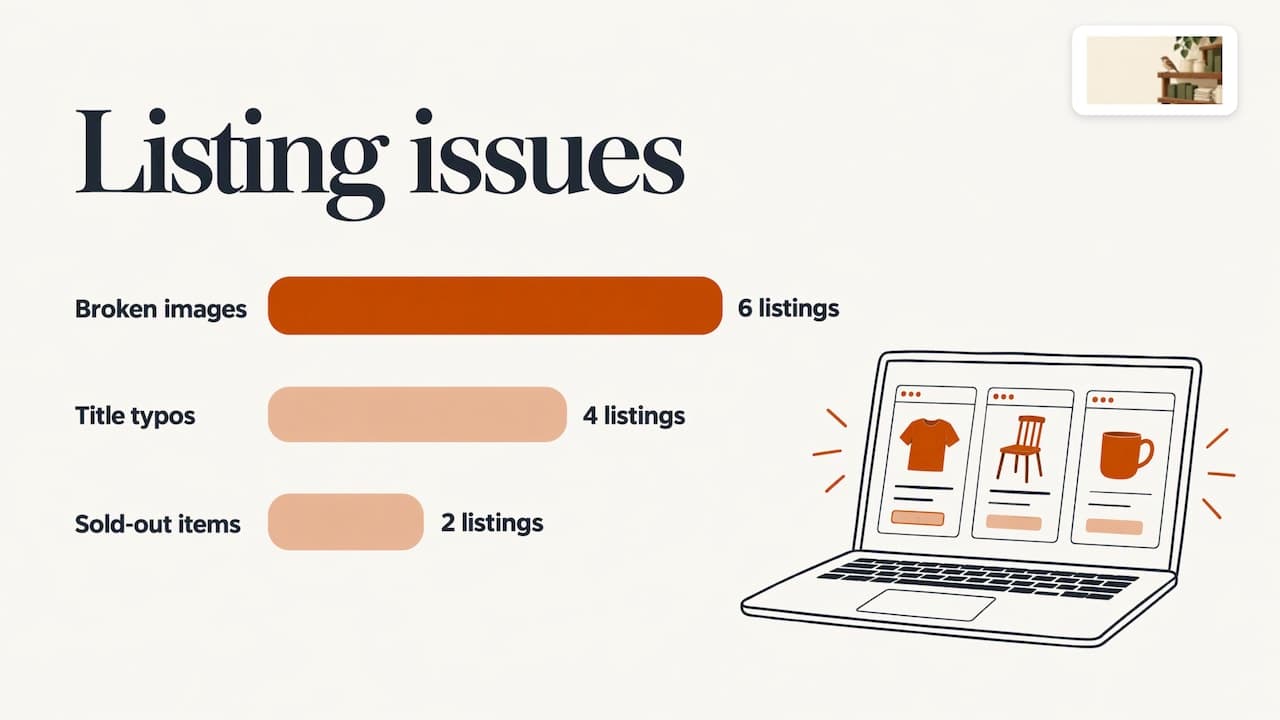
Take a small store with 120 listings. Say six have a broken image, four have a typo in the title and two bestsellers have sold out while still showing as available. None of these is dramatic. Each one nudges shoppers toward a competitor, and none triggers an error message, so nobody notices.
With a dashboard tool, you would log in, find the list, open each listing and fix it by hand: about a dozen edits plus the time to hunt them down. With a report-only audit, you would receive the same list and make the same edits yourself. With ShelfSparrow, the audit fixes the typos and images within 72 hours, and the monthly watch flags the stock problem in the daily summary and corrects routine listing errors before they pile up again.
The saving is not mainly money. It is attention. A calmer inbox and a short daily summary beat a to-do list that grows quietly.
Our view
We built ShelfSparrow because small stores rarely fail from one big mistake. They slip through small ones: a typo that sits for months, an image that stopped loading, a bestseller that ran low over a weekend.
Most tools in this category give you a screen and wish you luck. That works for a team with an operations person. It does not work for an owner who is also the packer, the photographer and the customer service desk.
So we do the work. The $297 audit fixes titles, SEO, typos and broken images within 72 hours. The $29 monthly service keeps a steady eye on your listings and stock, corrects routine errors, flags low stock and sends one daily summary. A little order, all day long.
When you compare options, ask one question of every provider: after it finds a problem, who makes the change? We think the answer should be “not you.”
Francis
FAQ
What is the best ecommerce inventory monitoring software for a small store?
It depends on whether you want to operate a tool or have the work done. For small sellers who want listings checked, fixed and kept accurate, ShelfSparrow’s $29 monthly service with a $297 audit is our pick, because it fixes issues rather than just reporting them. Software such as Sellbrite or Prediko suits owners who want to run a dashboard themselves.
How is monitoring different from an audit?
An audit is a one-time check of your listings at a moment in time. Monitoring is the ongoing watch that catches new problems after the audit. ShelfSparrow offers both: the $297 audit, then $29 a month for listing checks, stock alerts and daily summaries.
Does it work for Amazon, Walmart, eBay and WooCommerce, or only Shopify and Etsy?
ShelfSparrow audits any online store or marketplace, including Amazon, Walmart, eBay and WooCommerce, as well as Shopify and Etsy. That makes it a fit for sellers who list on more than one channel.
What does a low-stock alert do?
It tells you when an item’s quantity falls to a level you chose, so you can reorder before it sells out. ShelfSparrow sends stock alerts as part of the $29 monthly service and includes them in the daily summary, so you see them without logging in anywhere.
Why not just pay for a cheap freelancer audit?
Freelance audits on Upwork and Fiverr run from $35 to $1,299 and are mostly report only, with no monthly watch. A report still leaves you to make every change. ShelfSparrow’s audit makes the fixes within 72 hours and the monthly service continues the watch.